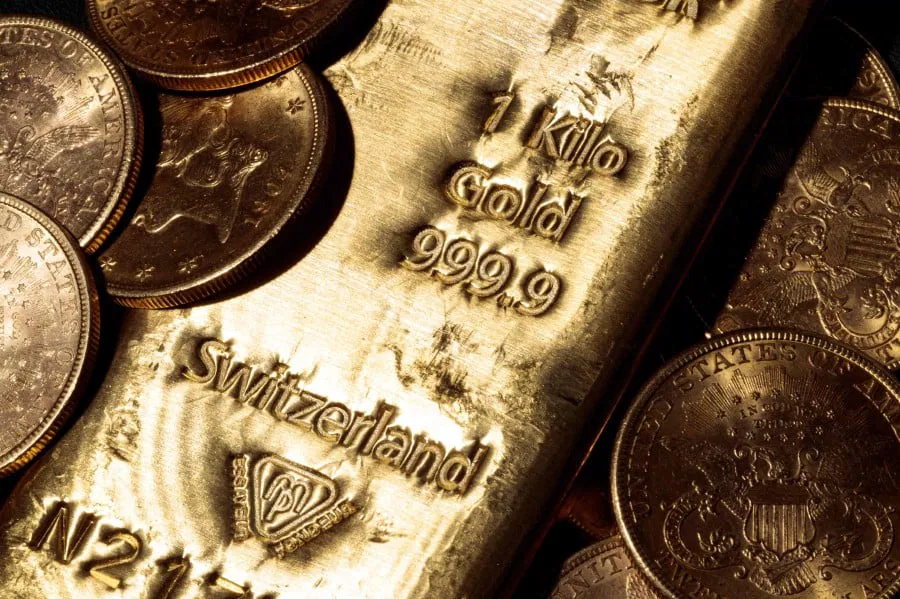
(New York, Feb 15) Gold prices have surged, and central banks have been buying aggressively—prompting speculation that gold may have overtaken U.S. Treasuries as the world’s largest reserve asset in value terms.
South Korea’s Chosun reported that as U.S. financial sanctions on countries such as Russia, China, and Iran have intensified in recent years, many central banks have reduced the share of dollar-denominated assets in their reserves and increased their gold holdings instead.
U.S. Treasury data showed that in the first three quarters of last year, global central banks were net buyers of about US$629 billion in U.S. government bonds. Over the same period, the value of central banks’ gold holdings rose by about US$684.7 billion, exceeding the growth in their Treasury holdings.
Data released this month by the World Gold Council (WGC)—mostly up to end-November, with some countries updated through end-October—showed that official gold reserves outside the United States have exceeded 900 million ounces (around 2,800 tonnes). Using gold prices as of Nov 30, Chinese media estimated the value of these holdings at about US$3.82 trillion, close to the roughly US$3.88 trillion in U.S. Treasuries held by foreign governments at the time. Using year-end prices, the value of non-U.S. official gold reserves was estimated at US$3.93 trillion, potentially surpassing foreign official holdings of U.S. Treasuries for the first time since 1996.
Falling confidence in fiat currencies
Joe Kalish, Chief Macro Strategist at NDR, said that as confidence in fiat currencies weakens, gold and other precious metals have become more attractive. He noted that while the gap between gold and Treasuries was still sizeable months ago, it has now largely disappeared.
The report added that rising gold prices also reflect efforts by countries to reduce reliance on the U.S.-centric financial system—driven in part by dollar depreciation and the desire to hedge against asset freezes or sanctions risk. It cited estimates that gold gained about 66% in 2025 and extended its rally into early 2026, reinforcing its role as a safe-haven asset.
Citing Duke University’s Fuqua School of Business professor Campbell Harvey, Chosun said major central banks are cutting exposure to dollar assets due to depreciation concerns and turning to gold as an alternative. Large-scale official buying has not only lifted prices but also created a structure in which reserve values and potential returns rise together.
Long-term outlook remains uncertain
Still, gold’s long-term trajectory depends on multiple factors, including U.S. monetary and fiscal policy, the mix of low rates and high inflation, the dollar’s performance, and whether central banks keep buying. Wall Street remains divided: many institutions are bullish—UBS recently upgraded gold to an “overweight”—while others take the opposite view, with Capital Economics projecting weaker gold prices in 2026.