Since AI became a core concept in smartphones, “context awareness” has emerged as one of the most intuitive ways for users to actually feel the presence of artificial intelligence.
From a purely technical standpoint, AI-enhanced photography or AI agents that automate app operations are undoubtedly more complex and impressive. However, the reality is that most users are not overly concerned about incremental improvements in camera quality. As for features like “automatic shopping” or “auto-playing games,” they may sound futuristic, but rarely fit into everyday usage.
By contrast, simpler context-aware features have proven to be far more practical: automatically connecting to home Wi-Fi, enabling Do Not Disturb mode before bedtime, providing traffic updates during commutes, or creating calendar reminders after receiving booking confirmations. These functions may be less technologically flashy, but they are where AI delivers the most tangible value.
That said, current context-aware systems are far from perfect. One of their biggest challenges lies in their limited compatibility with third-party apps.
The Friction Between Context Awareness and Third-Party Apps
When users shop online, order a ride, or book food delivery, smartphones can already extract relevant information such as logistics status or arrival times. They can even identify upcoming trips and proactively generate reminders.
While this is convenient for users, it presents a dilemma for third-party apps. The system often extracts behavioral data unilaterally, yet the resulting services—calendars, reminders, or smart cards—are routed to built-in system apps instead of back to the original third-party platforms.
This is partly a business decision. Phone manufacturers prefer not to “choose on behalf of users” among competing apps. For example, when users request navigation assistance, the system may provide a text-based response via the AI assistant rather than opening a specific map app, leaving the final choice to the user.
From a technical perspective, the industry still lacks a sufficiently secure and privacy-preserving method to enable deep interaction between system-level AI and third-party apps. However, this may soon change.
Google’s “Contextual Suggestions” Aim to Redefine the Experience
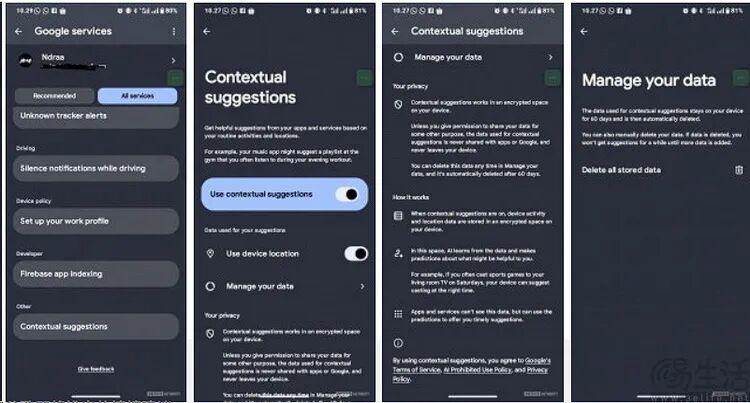
Reports suggest that Google is preparing to introduce a new system-wide AI feature for Android called “Contextual Suggestions.” Like existing solutions, it learns user habits and routines to proactively suggest actions at the right moment.
What sets Google’s approach apart is its ability to directly integrate third-party apps into these suggestions.
All learning happens locally on the device and is fully encrypted. No user data is uploaded, and habit records are retained only for a limited period—currently 60 days—after which they are permanently deleted.
Once a suggestion is generated, the system can trigger eligible third-party apps to perform specific actions. For instance, if the phone learns that a user listens to music while exercising at a certain time each day, it can automatically launch a music app and play workout-appropriate tracks.
Crucially, Android only sends instructions on “what to do,” not “why it should be done.” Third-party apps receive no access to behavioral analysis or statistics, helping safeguard user privacy.
While no solution is entirely foolproof, Google’s proposal represents a meaningful step toward smarter, more intuitive smartphones. By balancing automation, privacy, and third-party compatibility, contextual suggestions could significantly enhance how AI integrates into everyday mobile experiences.