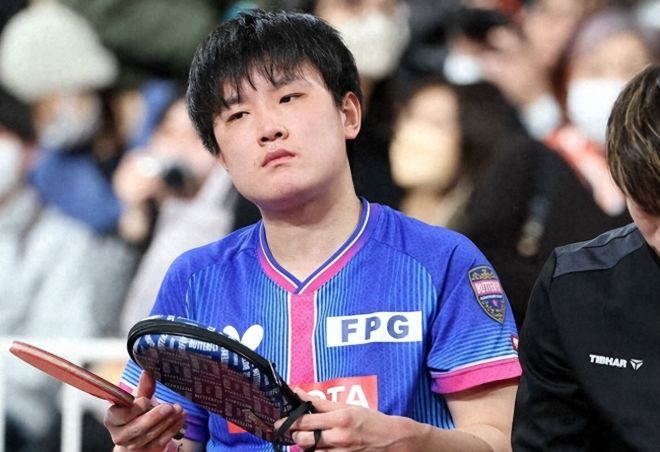
On January 29, the All-Japan Table Tennis Championships men’s singles concluded, with 18-year-old prodigy Hifumi Matsushima successfully defending his title with a 4-0 victory over Daiki Shinozuka. Yet the most talked-about moment came during the semifinals, where Matsushima’s controversial serve against Tomokazu Harimoto highlighted the clash between Japan’s emerging and veteran players.
In the seven-set thriller (13-11, 8-11, 8-11, 11-8, 14-12, 9-11, 11-9), Matsushima edged out Harimoto, ending his title defense for the second consecutive year. Trailing 0-6 in the first set, Matsushima switched his serve from backhand to center and adjusted his footwork, disrupting Harimoto’s rhythm and mounting a dramatic comeback.
In the final, Matsushima dominated 4-0 (11-8, 11-4, 11-4, 12-10), with a 91% success rate on backhand loops and fast attacks, including a 132 km/h power topspin in the third set, showcasing both technical skill and tactical mastery.
Harimoto publicly questioned Matsushima’s serving technique after the match, claiming “the toss height was insufficient and the spin unusual,” hinting that he would have requested a review if Hawk-Eye (TTR) were available. Table Tennis Kingdom noted that Matsushima’s serving strategy closely resembles Chinese Table Tennis Association chairman Liu Guoliang’s iconic 1996 Olympic serves—using positional and footwork shifts to disrupt opponent rhythm, even without extreme spin or power.
Harimoto, ranked world No. 5, has now lost in the semifinals to Matsushima for two consecutive years and admitted his form has dipped. Matsushima, now ranked No. 8, aims for the world top five. His powerful backhand topspin and tactical adaptability mark him as a cornerstone of Japan’s Los Angeles Olympic cycle.
Netizens criticized Harimoto for “losing both match and face,” yet Asahi Shimbun emphasized that the controversy reflects “the inevitable growing pains of technical innovation.” The rise of Hifumi Matsushima and Miu Harimoto (women’s singles champion) signals a technical breakthrough for Japan’s post-2000 generation. Chinese coaches note the importance of studying these new serve variations and backhand techniques to prepare for future international competition.
This serve-related controversy not only influenced match outcomes but also highlights a deeper strategic evolution in Asian table tennis—new-generation players integrating Chinese techniques may reshape the global competitive landscape.