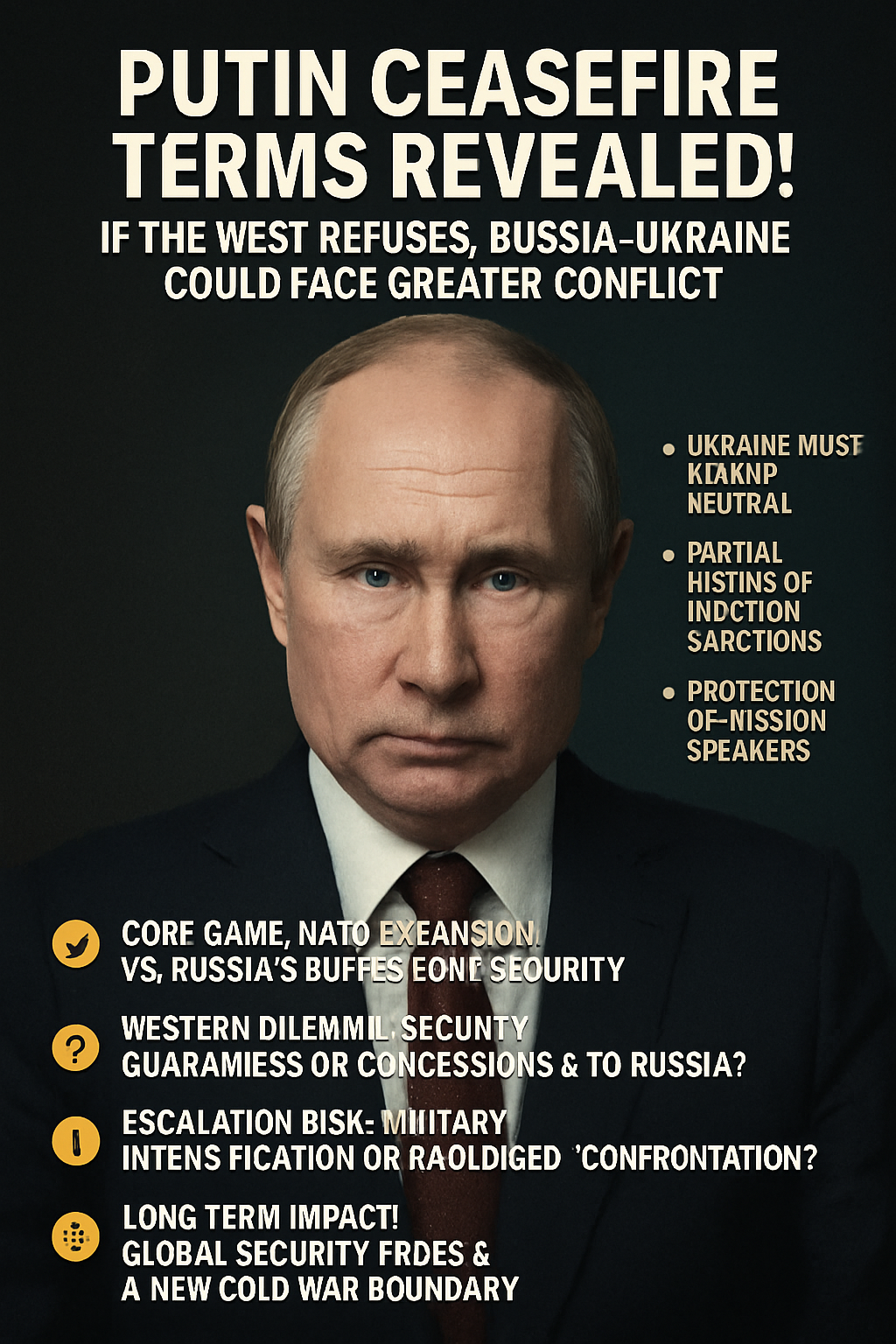
Three Russian sources familiar with the peace talks have revealed that Russian President Vladimir Putin has set out conditions to end the Russia-Ukraine conflict: Western leaders must sign a written pledge to halt NATO’s eastward expansion and lift most of the sanctions imposed on Russia.
A source close to the Kremlin said:
“Putin is willing to achieve peace, but not at any cost.”
According to these sources, Putin’s core demand is for Western powers to provide “written” guarantees that they will no longer pursue NATO’s eastward expansion—particularly excluding the possibility of Ukraine, Georgia, and Moldova (former Soviet republics) joining the alliance.
🟡 In-depth Analysis & Views
✅ Core Game: NATO Expansion vs. Russia’s Buffer Zone Security
Putin’s ceasefire terms essentially seek to “freeze” NATO’s eastward expansion, making Ukraine and other countries permanently neutral while restoring Russia’s influence over its traditional sphere of influence. This reflects Russia’s longstanding security concerns since the Soviet Union’s collapse.
✅ Western Dilemma: Security Guarantees or Concessions to Russia?
Ukraine and the West are unlikely to accept such conditions easily. Acceptance would mean abandoning Ukraine’s NATO aspirations and conceding to Russia’s demands—potentially emboldening further Russian aggression elsewhere.
✅ Escalation Risk: Military Intensification or Prolonged Confrontation?
If negotiations break down, Russia may launch even more intense military operations; and if Ukraine doesn’t receive strong security guarantees, it could ramp up its own military build-up, escalating regional tensions.
✅ Long-term Impact: Global Security Order & a New Cold War Boundary
Putin’s terms show that the conflict now transcends Ukraine alone; it’s a direct clash over Eurasia’s security framework. If NATO and the EU yield, it could reshape Europe’s entire security structure. If they refuse, a prolonged Russia-Europe confrontation seems inevitable.
Additionally, Russia has demanded:
- Ukraine must remain neutral
- Partial lifting of Western sanctions
- Resolving frozen Russian sovereign assets
- Protection of Russian speakers in Ukraine
One source warned that if Putin realizes he cannot reach a deal on these terms,
“He will seek to prove through military victory that tomorrow’s peace will be even more painful.”
So far, the Kremlin has not officially responded to these statements, but recent Russian military actions and diplomatic remarks have grown increasingly tough.
Last Sunday, Russia launched a large-scale air assault on Ukraine, using missiles and drones to strike multiple cities, including Kyiv. It was the largest attack since the war began in February 2022, killing at least 12 people and injuring many.
Former U.S. President Trump expressed “deep disappointment,” warning Putin he was “playing with fire.” On his social media platform, Truth Social, he posted:
“Vladimir Putin doesn’t realize that if it weren’t for me, many very bad things would have already happened in Russia… He’s playing with fire.”
Russian Security Council Deputy Chairman Medvedev hit back sharply on X:
“As for Trump’s remarks about Putin ‘playing with fire’ and ‘very bad things’ happening in Russia, I only know of one very bad thing—World War III. I hope Trump understands that!”
Putin and Russian officials have repeatedly insisted that any peace agreement must address the “root causes” of the conflict—in their view, NATO expansion and Western support for Ukraine.
Kyiv, on the other hand, has repeatedly emphasized it will not give up on NATO membership, arguing that Russia should not be able to veto Ukraine’s sovereign decisions. NATO has also reaffirmed its “open door” policy and said it will not change this fundamental stance for Moscow’s demands.