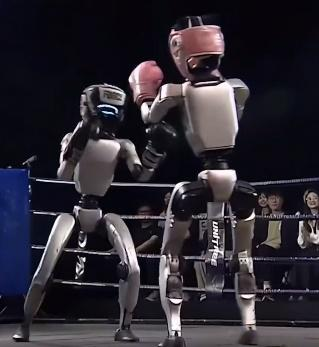
On the evening of May 25, the “CMG World Robot Competition · Series” Mecha Combat Arena event, hosted by China Media Group, kicked off in Hangzhou. This marks the world’s first combat competition featuring humanoid robots as the main participants, divided into exhibition and competitive matches. In the exhibition segment, robots challenged traditional human fighting sports, while in the competitive matches, “robot contestants + human operators” worked together to battle through multiple rounds for the championship.
As a partner, Unitree Robotics showcased four Unitree G1 robots. Under manual, voice, and motion-sensing remote control by human operators, these robots displayed a variety of complex combat moves, including straight punches, hooks, combinations, front kicks, side kicks, and dodges. Ultimately, the robot named “AI Strategist” claimed the championship thanks to its outstanding performance. CCTV sports host Yu Jia praised the robots’ detailed and impressive movements, noting significant technical advancements achieved in just two months.
Li Gaofeng, a researcher at Zhejiang University’s College of Control Science, also gave high praise, stating that the robots’ actions were smooth and natural, with some movements rivaling those of professional boxers. However, he emphasized that AI algorithms and real-time dynamic responses are at the core of the technology, and there remain many challenges behind the combat. Currently, humanoid robots still face limitations in hardware sensitivity and structural durability, and achieving high-level control by algorithms requires significant technological breakthroughs.
Force sensors are crucial for precise robot movement control. In particular, six-dimensional force sensors, which measure forces and moments at the end of limbs, provide high-precision feedback for control and operation. However, these sensors pose high technical barriers, with challenges in research, production, and costs, limiting the development of humanoid robots to some extent.
Despite these challenges, China’s humanoid robot market shows great potential. According to the China Humanoid Robot Industry Conference, the market size in 2024 is estimated at RMB 2.76 billion. The Ministry of Industry and Information Technology’s “Guidance on Promoting the Innovative Development of Humanoid Robots” aims for large-scale development and diversified applications by 2027, positioning the sector as a new engine for economic growth. Unitree Robotics founder Wang Xingxing expects that by the end of 2025, the industry will see significant breakthroughs in service and industrial applications, while the household humanoid robot market may take longer to mature.
🟦 Highlights
✅ World’s first humanoid robot combat competition
✅ Robot movements refined and professional, rivaling boxers
✅ AI algorithms and real-time dynamic responses remain technical hurdles
✅ Six-dimensional force sensors and other components still face technical bottlenecks
✅ China’s humanoid robot market shows strong growth potential
✅ Ministry of Industry plan: large-scale adoption and diverse applications by 2027