From Grand Entry to Quiet Retreat
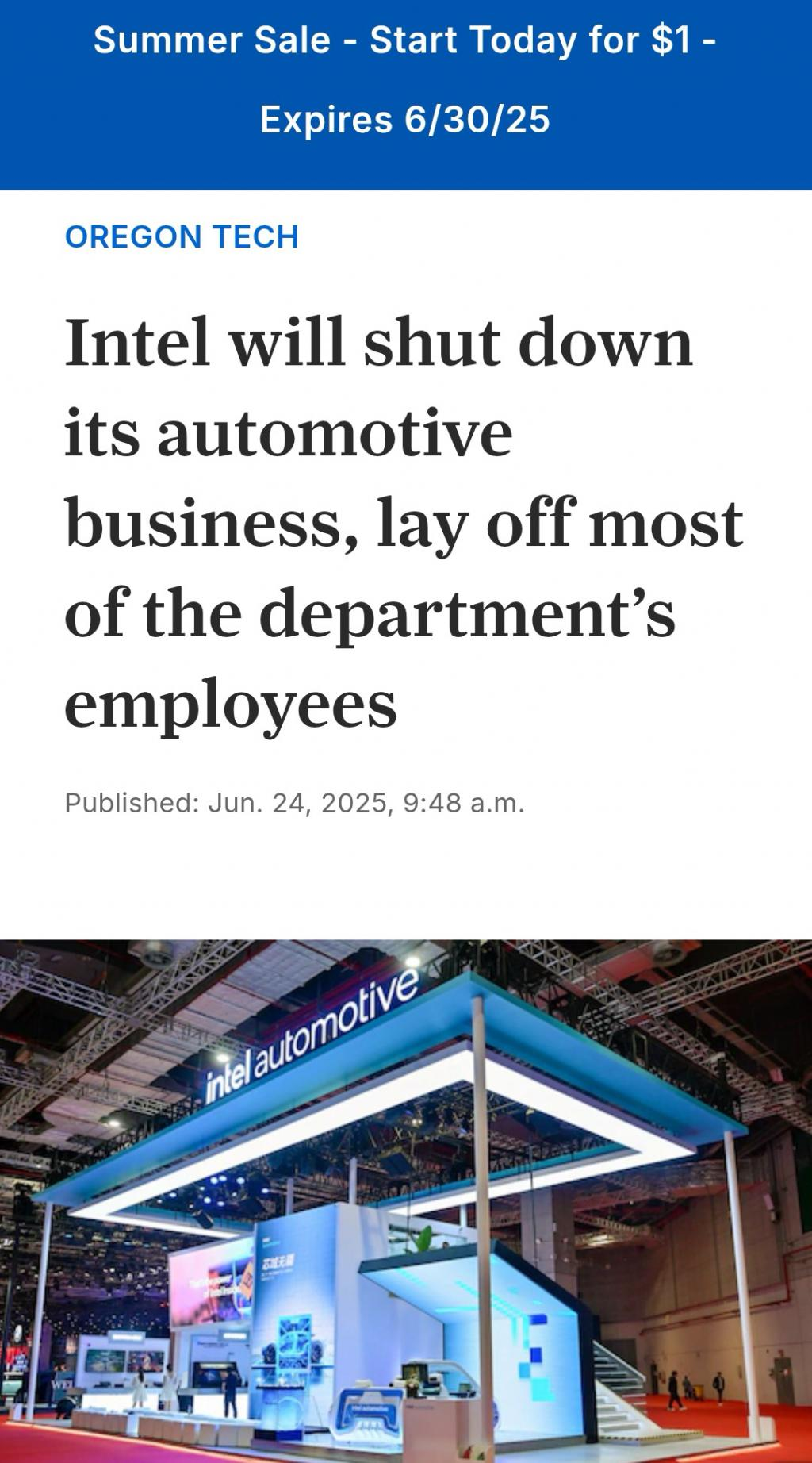
Intel showcased its latest SDV chip at the 2025 Shanghai Auto Show and formed partnerships with several Chinese AI firms. But in a dramatic reversal, the company announced the closure of its automotive division, including layoffs across R&D, engineering, and project management. Intel claims it's refocusing on data center and core customer businesses—clearly signaling a complete withdrawal from automotive.
Autonomous Dreams vs. Financial Realities
Intel entered the auto space in 2015 and made headlines with its $15.3 billion acquisition of Mobileye. However, years of investment yielded low returns. Intel's 2024 financial report showed a 2% revenue decline and a net loss of $18.7 billion. Amid factory halts, asset sales, and aggressive layoffs, an unprofitable car unit became expendable.
Tech Lag, Market Silence
While NVIDIA's Orin and Thor chips reached 254–2000 TOPS, Mobileye's EyeQ series struggled with 30–100 TOPS. Worse still, Mobileye's all-in-one hardware/software approach contradicted the growing demand for flexible, modular systems. Chinese chipmakers like Horizon Robotics and Huawei offered openness, speed, and adaptability.
Abandoned by Automakers, Marginalized in Market
Mobileye holds just 2.9% of China’s L2+ ADAS chip market, while NVIDIA, Tesla, and Huawei dominate nearly 90%. In cockpit chips, Intel trails far behind Qualcomm, Renesas, and MediaTek. Former partners like Zeekr and Geely have switched to NVIDIA, and other EV giants favor local or self-developed solutions.
Shrinking Space for Third-Party Chipmakers
With EV brands like BYD, Li Auto, Xiaomi, and XPeng launching their own chips, the room for general-purpose third-party vendors is vanishing. Mobileye’s former 36% global ADAS share is now a distant memory.
Final Thoughts:
Intel may still hold onto Mobileye, but that alone won't restore its automotive relevance. In a market shaped by fast-moving Chinese EV players and an ecosystem built on openness and collaboration, Intel's closed model and slow iterations were no match. Its exit marks more than just a failed investment—it reflects a fundamental mismatch with a new market logic.