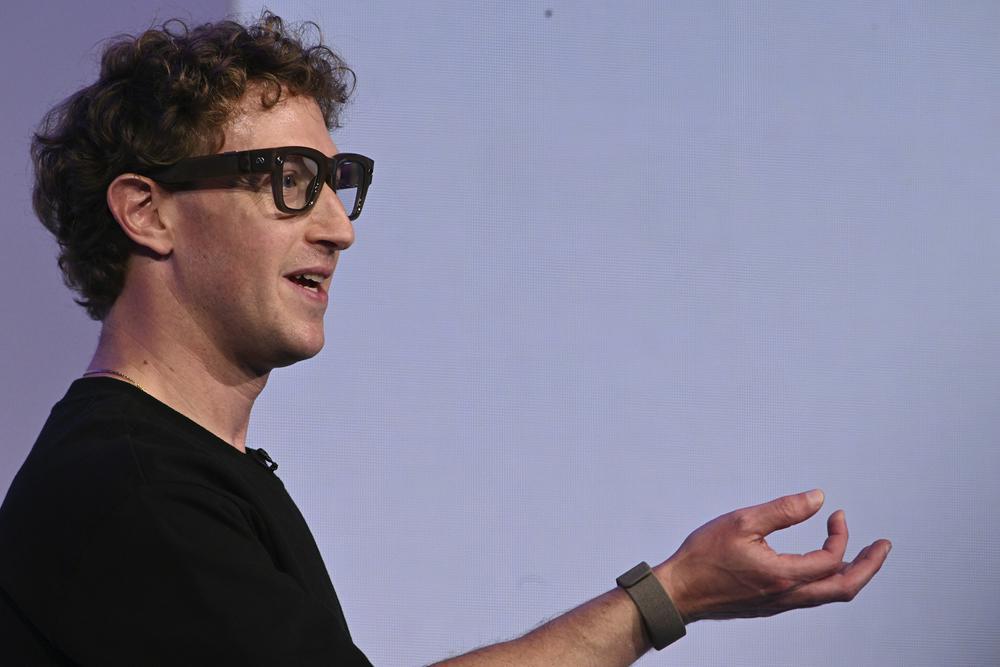
At the September 18 Meta Connect Developer Conference, the spotlight was firmly on Meta’s latest push into wearable technology. Three new AI-powered smart glasses were unveiled:
- the upgraded second-generation Ray-Ban Meta AI glasses,
- the sport-focused Oakley Meta Vanguard, and
- the headline-grabber, Meta Ray-Ban Display—the company’s first pair of smart glasses equipped with a built-in display.
A Dazzling Start, Followed by a Rocky Demo
The event began with flair. Meta CEO Mark Zuckerberg walked from backstage to the main stage, wearing the Meta Ray-Ban Display, as the audience watched his first-person perspective livestreamed on the big screen. In the corner of his view, icons showed music playback and incoming messages. Impressively, Zuckerberg managed to reply to texts mid-walk—without ever reaching for his phone.
But as the live demonstration continued, the spectacle quickly ran into trouble.
- During the showcase of “Live AI” real-time interaction, the Ray-Ban Meta AI glasses repeatedly failed to recognize voice commands, giving redundant responses until the demo was cut short.
- Moments later, Zuckerberg attempted to accept a video call on the Meta Ray-Ban Display—only to discover that the screen lacked an accept button. The call never connected.
With a touch of humor, Zuckerberg quipped: “The irony of spending years developing technology, only for the Wi-Fi to trip you up on the big day.”
What Makes Meta’s Display Glasses Different
Despite the technical hiccups, the Meta Ray-Ban Display packs impressive innovations.
- It features a full-color, high-resolution display that activates only when needed, conserving power.
- The glasses boast 6 hours of battery life, with a portable charging case extending usage up to 30 hours.
- Unlike many smart glasses that rely on phones or rings for control, the Display model comes with a neural wristband. This device translates subtle muscle movements into commands—allowing wearers to scroll or click with just the twitch of a hand.
However, these advances come with trade-offs. The Display uses a single-eye projection instead of dual-eye, and its 20° field of view means the virtual screen appears relatively small. According to a Chinese AI glasses executive, Meta’s focus on full-color visuals aligns with its positioning as an entertainment and lifestyle product rather than a pure productivity tool—but it also pushes up costs.
Price Tag and Market Reality
The Meta Ray-Ban Display starts at $799 (approx. ¥5,676 RMB), bundled with the neural wristband. It will first hit select U.S. stores on September 30, expanding to Canada, France, Italy, and the UK in early 2026.
- By contrast, the first-generation Ray-Ban Meta launched at just $299, while the second-generation starts at $379.
That first generation, released in 2023, was a breakthrough moment for the industry. Backed by Ray-Ban’s parent company EssilorLuxottica, sales tripled year-over-year and reached 1 million units globally in 2024, helping drive a 7.3% revenue boost. According to IDC, shipments of AR/VR headsets and AI-enabled smart glasses without displays are expected to surge 39.2% in 2025, largely thanks to the Ray-Ban Meta line.
Why China’s “Copycat Wave” Won’t Return
The runaway success of the original Ray-Ban Meta triggered a flood of imitators. Chinese tech giants like Baidu and Xiaomi, as well as startups like Thunderbird Innovation, launched similar products, some even boasting ambitions to go “Beyond Meta.”
But industry insiders argue the Display model won’t spark the same replication frenzy:
- The Price Barrier – At nearly $800, it sits well above mass-market affordability, limiting its appeal.
- Technical Barriers – Unlike simpler AI-camera glasses, display-equipped wearables demand breakthroughs in optics, power efficiency, and interaction design—hurdles not easily cleared.
As one executive put it: “The Meta Ray-Ban Display may not be a commercial blockbuster, but it introduces exciting new ways of interacting with smart glasses. The neural wristband alone could inspire the next wave of innovation.”
The Bigger Picture
Zuckerberg has often described display-free glasses like the Ray-Ban Meta as a stopgap—affordable, fashion-forward tools that satisfy demand until true holographic display technology matures. In the future, he predicts three categories will coexist:
- High-end holographic glasses that deliver immersive, premium experiences,
- Affordable AI-first glasses optimized for everyday utility, and
- Hybrid display models like the Meta Ray-Ban Display, bridging the gap with novel interactions.
For now, the Display model’s rocky debut shows the challenges ahead. But it also underscores Meta’s determination to push wearable AI beyond gimmicks—toward a future where glasses don’t just look smart, they truly act smart.