When Alice stepped through the looking glass and encountered the Red Queen, they ran forward with all their strength yet remained in the same place—because the world around them moved just as fast. The Red Queen told Alice, a visitor from a slower and gentler era: “In this land, you must run as fast as you can just to stay where you are.”
Both Meituan and Alibaba have now released their quarterly earnings, reflecting the brutal financial aftermath of what has been called “the food-delivery war”—especially the intense months of July and August. The results give us a clearer view of the cost of this fierce, almost primal battle.
In the latest earnings reports, Alibaba’s profits plunged by 85% year-on-year, and Goldman Sachs estimates that instant retail contributed about 36 billion RMB in losses. Meituan’s Q3 revenue hit 95.5 billion RMB, but grew only 2% year-on-year, while its core local commerce business recorded an operating loss of 14.1 billion RMB, and an adjusted net loss of 16 billion RMB.
Jiang Fan stated that Taobao Flash Sales has completed its phase of rapid expansion and is transitioning into “efficiency optimization mode”—a clear signal that subsidies may decrease to reduce losses. Meituan also made it clear that operating losses will likely continue into Q4.
Lowering costs and shrinking losses will be the major theme for both companies in the next quarter. But the real question is: can either side afford to stop this exhausting marathon simply to stay in place?
This brings us back to the “Red Queen Hypothesis” derived from Alice in Wonderland. The concept has two key interpretations:
First, species do not evolve in isolation but co-evolve with competitors.
Second, when one species gains a new advantage—such as greater speed—it doesn’t simply gain dominance, but forces every other species in the ecosystem under extinction pressure.
The ultimate result of this relentless acceleration is rarely decisive victory. More often, it is a fragile equilibrium—where everyone races forward, yet relative positions remain unchanged.
It’s hard to find a better metaphor for this year’s “delivery war.” Since the summer of 2025, China’s internet industry has been trapped in such a Red Queen race—one where the key variable is speed.
You must start running to keep up—and once you run, you discover that consumer demand is full of unexpected surprises.
Take clothing as an example.
Fashion has always been a core e-commerce category. When Alibaba first designed the Double 11 shopping festival, one of its internal hypotheses was simple: winter is coming, people will soon need warm clothing.
Implicit in that logic was a belief that clothing purchases are planned. Consumers browse, compare prices, place orders, wait for discounts, and then wait a few more days for delivery.
But today, even clothing has entered the realm of instant gratification. A friend of mine who sells athletic wear in Beijing told me that they frequently receive small but steady orders for yoga pants… at one in the morning. After investigation, they discovered the pattern: these are business travelers who want to exercise but didn’t bring gear—so they simply place a one-hour Flash Sale purchase.
So which came first—the demand or the capability? Did consumer behavior drive platforms to accelerate, or did the existence of instant retail create such consumer impulses? Either way, something fundamental has mutated in the e-commerce ecosystem.
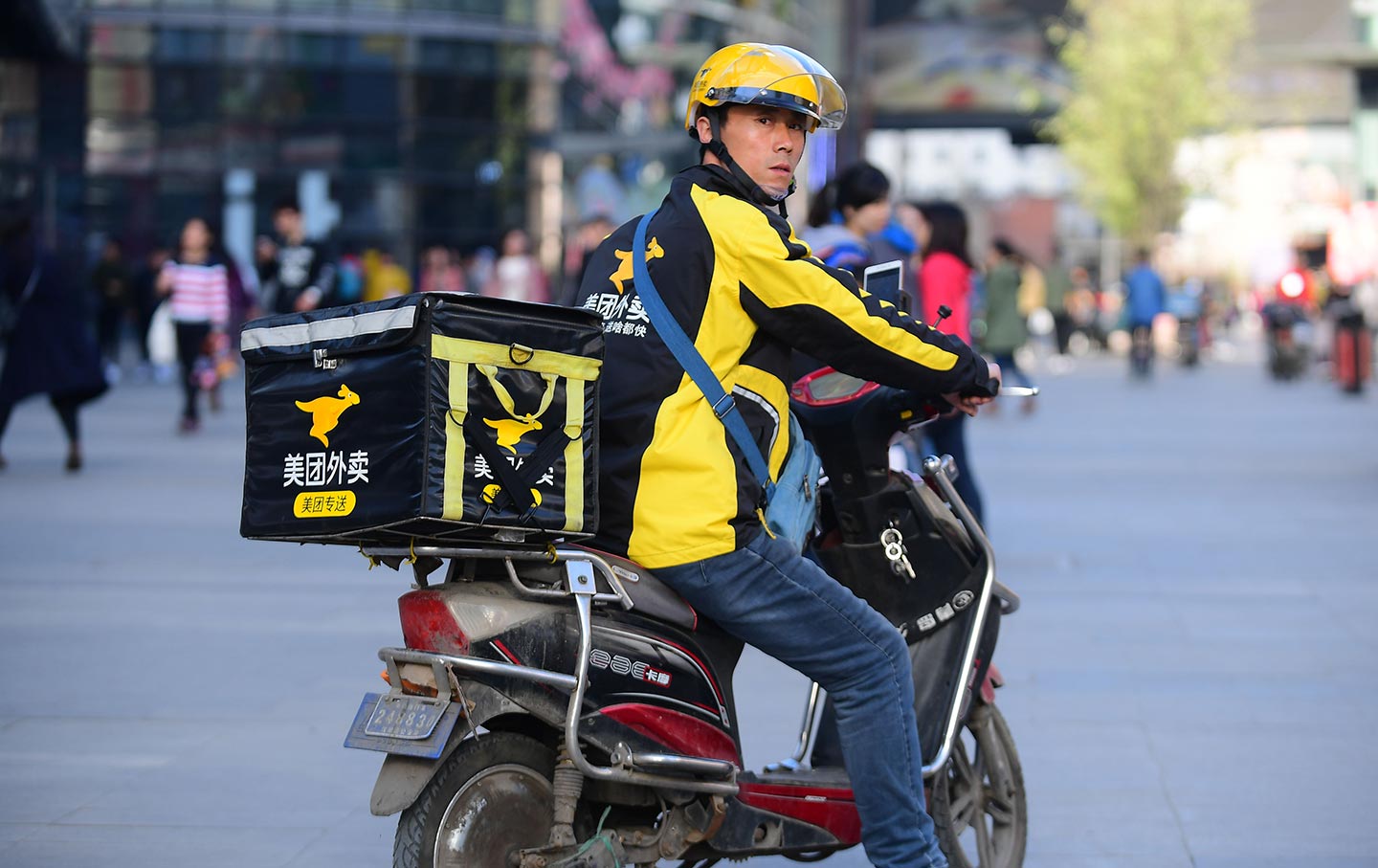
Meituan was the first species to evolve—compressing fulfillment times from days to minutes using hundreds of thousands of riders. The effect was immediate and devastating for Alibaba: once consumer patience is trained to tolerate only 30 minutes, the old empire built on “bulk ordering” and “delayed gratification” no longer faces growth challenges… but survival challenges.
Alibaba had no choice—it had to run too. It’s said that one reason Jack Ma has backed Jiang Fan’s cost-agnostic strike against Meituan is to prevent another Pinduoduo scenario from repeating itself.
E-commerce optimizes for “more, faster, better, cheaper.” Pinduoduo owns cheap. If Meituan locks down fast, then Alibaba’s once-stable market position could tremble again.
So we end up with a curious coincidence.
In August, Meituan announced that its network of lightning warehouses surpassed 50,000 units. Just days later, Alibaba revealed the same number: 50,000 lightning warehouses for Taobao.
I asked a friend familiar with Meituan whether Alibaba’s rapid catch-up adds pressure. He replied that while pressure surely exists, the figure is misleading: there may only be around 50,000 warehouses in total, and many merchants—encouraged by Alibaba’s subsidies—are simply operating across both platforms.
Even if Alibaba didn’t expand the total capacity, its agility is undeniable. It isn’t just copying Meituan’s model—it is also signaling to the market that with enough subsidies and operational alignment, the intricate infrastructure that Meituan spent five years building can—at least theoretically—be replicated in months.
But this raises the deeper question: what is Meituan’s true moat?
Some say it lies in operational efficiency—the ability to minimize transaction friction. Meituan is in the business of “bending down to pick up coins”—low-margin, high-complexity. Even one unoptimized cost point could vaporize its 4% delivery margin or 3% overall margin. In past interviews, Wang Xing and Wang Pu-zhong have repeatedly expressed confidence in their efficiency.
But that moat only works if the competitor also wants to make money. If the competitor treats this business as a defensive shield—prepared to plow in money indefinitely—then Meituan’s “low-margin fortress” may not be as impregnable as assumed.
Subsidies cannot last forever, and waiting for the competitor to give up is one strategy. But Meituan—and Wang Xing personally—have never been “passive-waiting” types. A counteroffensive this winter is very likely.
And in fact, the opening moves have already begun.
During this year’s Double 11, Meituan—though overshadowed by Alibaba, JD.com, and even upstarts like Xiaohongshu—introduced a key new business: Official Flash Warehouses. These host official flagship store inventories for brands like Kefumei, Maogeping, BANXIA, Sony, and more.
Why is Meituan suddenly courting major brands rather than long-tail sellers?
We can think of e-commerce evolution in three phases:
Phase 1: The Wild Frontier
Platforms need quantity. White-label, low-quality goods act as market fillers. Efficiency doesn’t matter—activity does.
Phase 2: The Efficiency Phase
Traffic becomes expensive. Platforms prioritize conversion. Out of 100 customers, big brands convert 80, small brands only 20. So inefficient sellers are eliminated.
Phase 3: The Monetization Phase
Dominance established, growth slows. Platforms focus on extracting value—search ads, bidding, rent-seeking.
Meituan Flash Sales is mid-air between Phase 1 and Phase 2—an unstable, risky transition. Evolution is mandatory. Low-margin white-label goods cannot support the high delivery cost of instant fulfillment.
For example:
On Taobao, selling a 9.9 RMB phone case yields profit, because shipping is 2 RMB.
On Meituan, selling the same phone case incurs 7 RMB courier costs—guaranteed loss.
To keep the machine running, Meituan needs higher-ticket brands. Increasing average transaction value is core to Meituan’s strategy.
And importantly, bringing in major brands increases the complexity of the game.
In supply chain theory, there’s the “Bullwhip Effect”—where a tiny fluctuation in consumer demand amplifies into huge swings in upstream manufacturing signals. Instant retail—with its thousands of micro-warehouses—magnifies this volatility dramatically.
The more nodes, the less predictable inventory becomes, and the higher the risk of overstock or stockouts. If this goes wrong, Meituan’s finely-calibrated low-margin model could fracture—and indeed, the latest financials show that when delivery weakens, in-store commerce suffers in tandem.
Meanwhile, Meituan is syncing with traditional e-commerce services.
Return a dress that doesn’t fit? A courier arrives in 30 minutes—for free. Buy an AC unit? Installation same day—no need to take two days off.
And Alibaba? It certainly has deeper brand partnerships. But can it follow?
Many assume Alibaba will mimic Meituan—sign brand collaborations, build infrastructure, achieve 1-hour or faster delivery. Financially and organizationally, Alibaba can do this if it commits.
The real problem is: Alibaba may not be willing to commit.
As noted earlier, Alibaba’s main body—Taobao and Tmall—sit firmly on the Phase 3 “monetization throne,” accustomed to generating profit through paid placement and ad revenue. This is the comfortable “landlord” model.
But Alibaba’s new limb—instant retail—is still in Phase 1: a rough, labor-heavy, cash-burning “field-worker” model.
Two souls from two eras inhabit one corporate body. The resulting time-lag creates internal friction—sometimes even self-cannibalization.
Classical e-commerce is built on absorbing time. The longer a user stays in the app, the more ad impressions, the more revenue.
Instant retail is built on eliminating time. Search, click, receive—done.
This creates a paradox: every efficient Flash Sale transaction might eliminate a profitable Tmall supermarket order that consumers would have otherwise tolerated for next-day delivery.
Put bluntly: Taobao Flash Sales competes not only against Meituan… but against Taobao itself.
In companies, departmental interest often outweighs total corporate interest—because bonuses and KPIs flow through departments. Taobao welcomes Flash Sales as long as it brings new traffic—but if Flash Sales starts cannibalizing Taobao’s core, internal pushback is inevitable.
Similarly, the widely-criticized “Taobao Convenience Stores” effort—mirroring Pinduoduo’s official in-app merchants—also reflects internal compromise. The instinct to leverage the Taobao brand collided with the optics of competing against small merchants.
These tensions reveal Alibaba’s internal time-lag: the main platform wants to “collect rent,” while the new business requires “building infrastructure.” The result is permanent balancing and internal negotiation.
During the latest earnings call, Jiang Fan announced gradual reductions in instant retail subsidies. This is not just financial logic—it hints at inability to reconcile internal interests. After all, launching instant retail within a profit-obsessed empire is like rebooting startup culture inside a corporation that has forgotten how to be scrappy.
For Meituan, this is good news. It can move smoothly into Phase 2—raising average transaction value and monetization rates—likely focusing on premium brands and membership.
Meituan’s memberships now offer more perks: more coupons, faster delivery, priority services. The “free return pickup” perk was first rolled out to members—making some customers faster than others.
A friend put it well: “Some money can only be earned by systems with extremely precise efficiency formulas.”
Ultimately, e-commerce has become a contest of speed and price. To win, a company must operate with higher efficiency. Saving even 0.5 RMB on each transaction increases market share—but where does that 0.5 come from?
Alibaba’s answer: the company covers it itself.
Meituan’s answer: detune the efficiency algorithm—favoring premium brands and loyal members.
And in the wings, TikTok (Douyin) with superior algorithms and Pinduoduo with ruthless monetization experience wait for their moment. Even if they haven’t formally entered instant retail, they’re already in the arena strategically.
In the land ruled by the Red Queen, no one can stop running.
Alibaba may still defend its empire—it has deep capital reserves and a powerful brand moat. But its utopian mission—“to make it easy to do business anywhere”—has shattered into countless specific, real-world equations about inventory turnover and fulfillment cost. It must sprint in place: maintaining its revenue engine while repairing the cracks opened by instant delivery.
Meituan, the gritty endurance runner with no retreat, must keep charging ahead in the mud. It must win its bet on “anti-bullwhip-effect” optimization and ensure that the girl ordering yoga pants at 3 a.m. not only gets them—but gets them delightfully fast.
Perhaps the ending of this war was already foreshadowed in Marx’s timeless observation on modernity: “All that is solid melts into air.”
In the classical era of e-commerce, the “solid” was the boundary between online and offline, the three-day-delivery social contract, the patience consumers once had to exchange time for price.
We enjoyed the ritual of opening parcels—just as we enjoyed the ritual of a planned, orderly life.
But now, everything is dissolving at the friction point between algorithms and logistics.
Boundaries have liquified. Warehouses have infiltrated office buildings. Patience has evaporated. Desire demands fulfillment instantly. The old bulk-stocking logic has become fluid instant-need logic. The grand empires of e-commerce have fragmented into micro-battles in neighborhood delivery zones.
When instantaneousness becomes the sacred new principle, we gain a faster world—but lose the right to wait.
Perhaps this is simply the cost of evolution. And for the consumer desperately in need of a face mask emergency at 11 p.m.—who cares about the collapse of the old world?
What matters is the moment the doorbell rings.