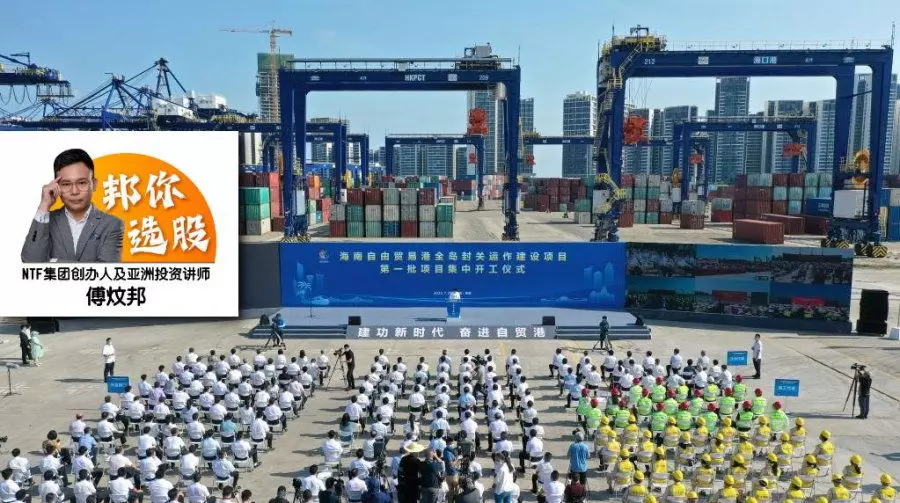
China’s Hainan Free Trade Port has recently officially launched its “island-wide customs closure,” marking a significant milestone in the upgrading of its cross-border trade framework, logistics system, and free trade port制度. Contrary to common misunderstanding, “customs closure” does not imply isolation. Instead, it reflects the full implementation of policies that bring customs procedures, tax arrangements, and logistics efficiency closer to international free port standards.
As Hainan’s role as a regional trade hub becomes increasingly defined—particularly in agricultural products, cross-border e-commerce, regional logistics, and food trade—its improved connectivity and clearance efficiency are expected to benefit Malaysian exporters, as well as port, logistics, and aviation-related companies over the medium to long term.
Did you know?
Take Lim Poh Kian Berhad (PLS, 9695, Main Market Plantation) as an example. Traditionally focused on palm oil plantations, the group has in recent years repositioned itself as a diversified agricultural platform encompassing oil palm, tropical fruits such as durian, and other crops, covering cultivation, processing, and export activities.
Its subsidiary, Dulai Fruits, holds official permits to export fruits to China and has established strategic partnerships with major Chinese distributors, including the Guangzhou Jiangnan Group and state-owned COFCO Group. Leveraging COFCO’s nationwide distribution network, Lim Poh Kian’s durian and tropical fruit products are able to penetrate China’s domestic market more efficiently. Export volumes are expected to grow at an estimated annual rate of 30% over the coming years.
This demonstrates that Lim Poh Kian’s China strategy has moved beyond conceptual positioning and has translated into tangible market access and supply-chain integration.
Three Key Ways Lim Poh Kian Could Benefit
The potential benefits of Hainan’s customs closure for Lim Poh Kian can be summarised as follows:
First, improved distribution and logistics efficiency. Enhanced trade connectivity between Hainan and ASEAN could reduce clearance times and regulatory costs, enabling time-sensitive products such as durian to reach China’s coastal and inland markets more quickly and cost-effectively.
Second, deeper collaboration with Chinese commercial partners. The customs closure is likely to attract greater capital and industrial concentration in Hainan, potentially opening doors for Lim Poh Kian to expand cooperation in cold-chain logistics, supply-chain integration, and regional distribution platforms—enhancing brand visibility and channel depth.
Third, structural demand growth. China’s demand for Malaysian durians and frozen tropical fruits continues to rise. Hainan’s institutional and logistical enhancements provide greater certainty and sustainability to future export growth.
That said, risks remain. Lim Poh Kian’s fundamentals still require improvement, competition within the agricultural export sector is intense, and policy benefits may take time to materialise. Hence, Hainan’s customs closure should be viewed as a medium- to long-term structural tailwind rather than a short-term catalyst.
Beyond agricultural exporters, port and logistics players such as MMC Corporation (MMCCORP, delisted), Xinhua Holdings (XINHWA, 5267, Main Market Transportation & Logistics), as well as aviation and airport operators like Malaysia Airports (AIRPORT, delisted), may also benefit from enhanced regional trade flows. Higher port throughput, rising cross-border logistics demand, and growth in air cargo and passenger traffic represent potential upside areas.
Conclusion
Overall, Hainan’s island-wide customs closure presents long-term structural opportunities for Malaysian exporters and logistics hub operators. For investors, focusing on companies with established export capabilities and concrete linkages to the China market—while integrating both fundamental and technical analysis—may offer an effective approach to capturing the ASEAN–China trade growth narrative. Lim Poh Kian Berhad stands out as one such company worthy of close monitoring.
As with any investment, thorough research and an assessment of one’s own risk tolerance are essential before making any investment decisions. Investors trade at their own risk.