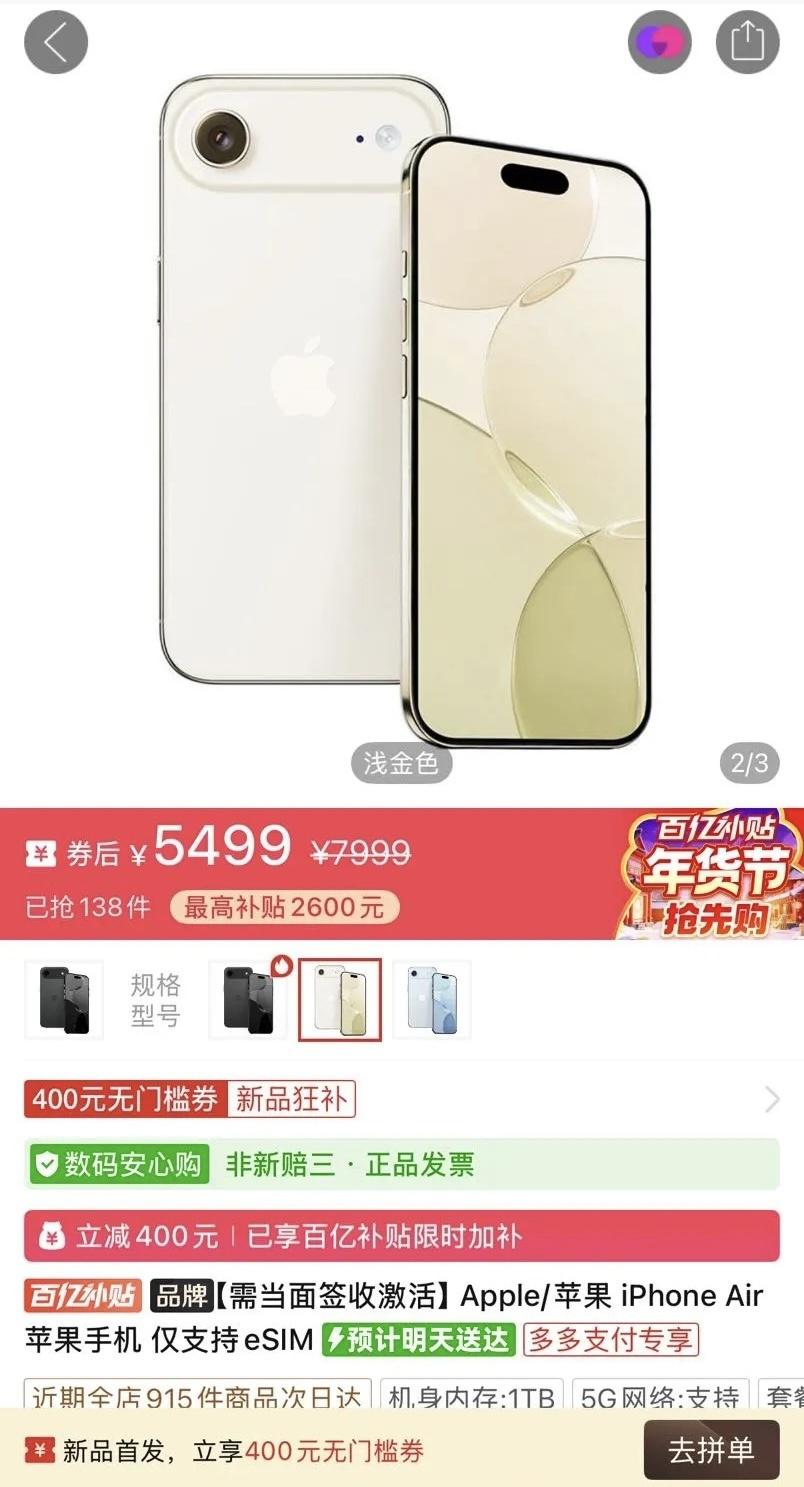
On January 25, the China mainland version of the iPhone Air entered an unprecedented large-scale price reduction across multiple platforms, including Apple’s official Tmall store, JD.com’s Apple flagship store, Pinduoduo’s “Billion-Subsidy” program, and various authorized offline retailers. The promotion is expected to last at least until February 11.
Originally launched in late October at a starting price of RMB 7,999, the iPhone Air is now discounted by RMB 2,000, with an additional RMB 500 government subsidy, bringing the entry price down to RMB 5,499. On some platforms, trade-in incentives further reduce the price to as low as RMB 5,099—nearly RMB 3,000 below its launch price.
The participation of Pinduoduo suggests that the long-term market price of the iPhone Air in third-party channels may stabilize around RMB 5,000 or even drop lower.
By comparison, during last year’s 618 shopping festival, the 128GB iPhone 16 Pro dropped from RMB 7,999 to RMB 5,499 (after subsidies), with some platforms pricing it below RMB 5,000, turning it into a sales champion through aggressive pricing. However, the iPhone Air is unlikely to replicate this success—even Apple appears to be aware of that.
Sales allocations during the Spring Festival promotion show that only about 13,000 units of the iPhone Air were made available on Apple’s Tmall flagship store, compared to 200,000 units of the iPhone 17 Pro series. The standard iPhone 17, which remains supply-constrained, was excluded entirely.
This is not due to Apple’s reluctance to sell more units, but rather limited demand and earlier production cuts. Supply-chain reports as early as October indicated weak global performance for the iPhone Air, prompting Apple to slash production—by over 80% in some estimates. The aggressive price cut just three months after launch strongly suggests a strategic inventory clearance.
In essence, the iPhone Air is being pushed prematurely into the latter half of its product lifecycle.
Apple’s strategy appears focused on reallocating resources. First, shifting capacity toward higher-demand models such as the iPhone 17 Pro and Pro Max, which dominate activation data. Second, freeing up production lines ahead of the rumored foldable iPhone, expected later this year, which requires longer and more complex supply-chain preparation.
At a deeper level, the iPhone Air’s failure in China stems from a mismatch between product positioning and market readiness. As the only China-market iPhone that supports eSIM exclusively, it appeals to a very narrow audience. Tech enthusiasts remain lukewarm about eSIM, while mainstream consumers find the transition inconvenient. Those who accept eSIM may not accept the compromises made for extreme thinness—and vice versa.
Ultimately, misaligned positioning, immature eSIM infrastructure, and pricing misjudgments combined to create this outcome.
While Apple is cushioned by the strong performance of the iPhone 17 lineup, the lessons from the iPhone Air will likely shape its approach to future foldable devices and next-generation Air models.