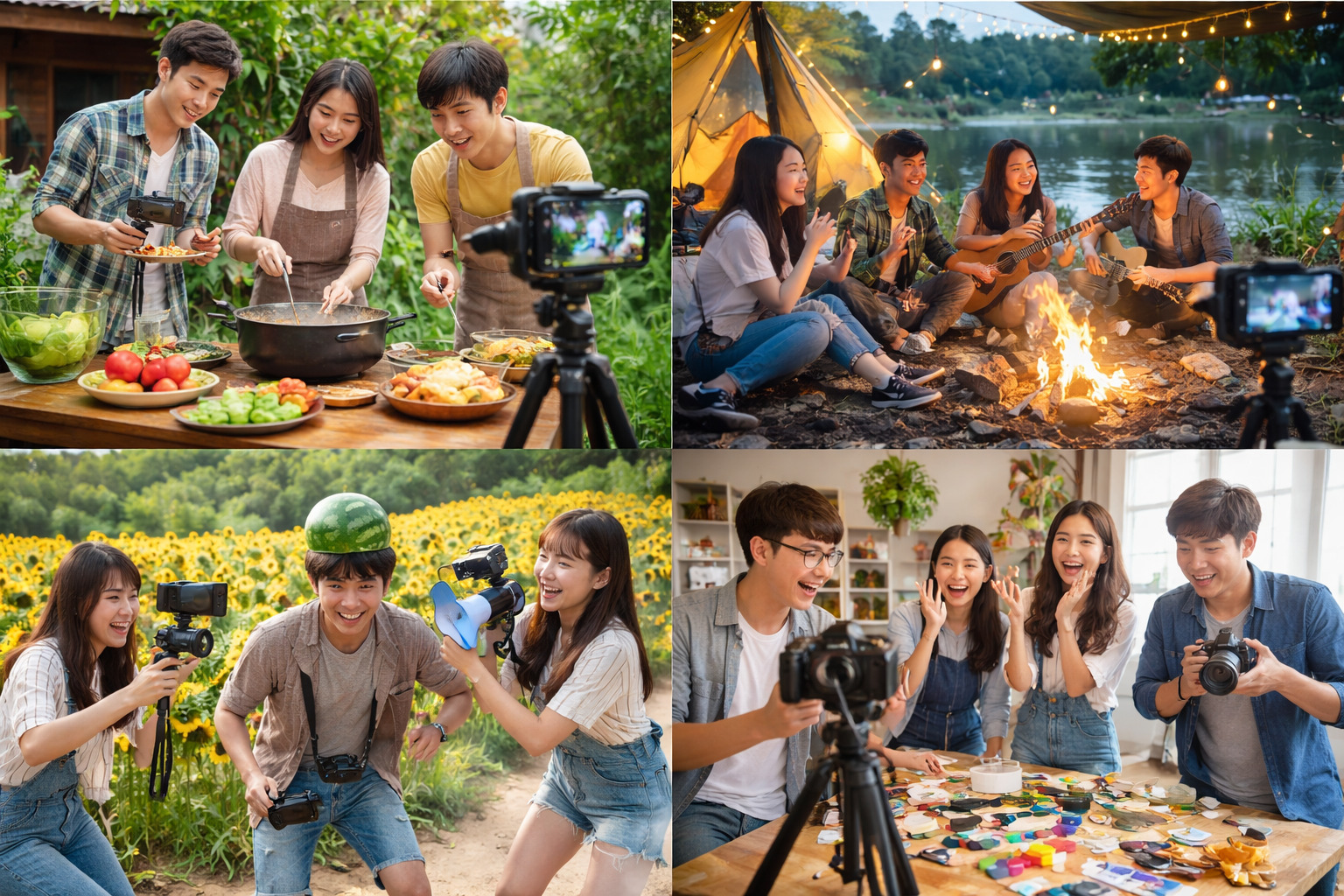
Whether driven by platforms or created by everyday users, the future of self-produced variety shows lies in building deeper, more meaningful interaction with audiences. “Co-creation” is the defining advantage of today’s self-produced formats—transforming viewers from passive spectators into active participants, while expanding the openness of content and the boundaries of discussion.
It is widely believed that the quiet rise of self-produced variety shows—especially those made by amateur creators—on short-video platforms owes much of its appeal to their lack of polish. The raw, unrefined texture and youthful sense of everyday life feel refreshingly authentic, drawing viewers in and prompting spontaneous likes and engagement.
Take Let’s Start Farming, College Students, created by three university students in Sichuan using just two cameras to document rural life. Their idea of returning home during summer break to farm offered audiences a genuine window into the countryside. Young viewers were intrigued by unfamiliar rural experiences, older audiences watched with a gentle, almost parental fondness, and children were captivated by this unconventional “variety show.” In a time when urban–rural cultural differences still exist, many viewers experienced a distinctly different kind of “micro-variety show” beyond their phone screens.
There were no staged scenes, no scripts, and no celebrities—just honest footage capturing a clumsy yet sincere performance of real life.
Short-video platforms were quick to recognize the new wave of amateur self-produced variety content. Platforms like Bilibili and Douyin stepped in, mobilizing internal resources to launch branded self-produced variety initiatives. What they value most is the low-cost, high-creativity production model. Compared with traditional variety shows, self-produced formats allow far more room for experimentation. Often, a single episode can be filmed with just one or two smartphones, and even with higher investment, costs remain significantly lower than those of conventional productions.
That said, platform-led programs inevitably carry a more “official” tone than purely amateur creations. Still, whether driven by platforms or creators, self-produced variety shows are reshaping how users consume entertainment.
01
The “Amateur” and “Authentic” Appeal of Self-Produced Variety Shows
Participants enter the scene, introduce themselves, showcase their talents to win over evaluators, and respond to unexpected challenges built into the environment—misplaced objects, obstacles on the floor, or sudden changes designed to test adaptability. Yet both “guests” and “judges” often appear slightly awkward on camera, occasionally breaking into laughter mid-performance. And that awkwardness becomes part of the charm.
This is precisely the appeal of GOGOGO Nanshi-er, a variety show self-produced by university students. While it may not generate blockbuster view counts, it embodies the core qualities of amateur variety shows: authenticity, spontaneity, and alignment with young people’s desire for self-expression and vitality.
Similar self-produced programs by students and everyday creators can be found across multiple short-video platforms. Most focus on casual conversations, shared performances like singing or dancing, and everyday life documentation. Some have achieved breakout success. For example, the Bilibili UP-creator show Who’s Next? regularly generates tens of thousands of real-time comments and averages around five million views per episode. Co-created by six UP creators, it has been featured in the platform’s “Weekly Must-Watch” lineup.
Alongside it, shows like Youth Travel Group, Sheep Village, and Bankrupt Team-Building bring together well-known creators within the platform, evolving toward serialized, column-style formats that now form a backbone of the platform’s content ecosystem.
The earliest prototype of self-produced variety shows on Bilibili can be traced back to Transforming Brothers in 2019. Six UP creators were given just 50 yuan each to survive in a rural village for two days. With no script and no staging, rural life itself became a “survival challenge.” As pioneers of amateur variety shows, the creators later launched sequels like Charge Ahead! Transforming Brothers and Break Out! Transforming Brothers, gradually establishing game rules and inviting more creators to join. The guiding principle remained simple:
Set only a loose framework. Let everyone improvise freely. Tasks are standard; surprises are the hook. Authenticity is the core attraction.
As their popularity grew, some creators transitioned into platform-produced variety shows, creating a two-way flow of traffic and complementary exposure.
Compared with Bilibili’s amateur-focused approach, Douyin has leveraged its internal celebrity resources more heavily. Platform-led programs like Nice to Meet You Concert emphasize interactions between singers and vulnerable communities, using music to deliver emotional healing. Meanwhile, carefully planned shows such as Good Night, Missy feature TVB actors dancing and engaging with audiences beyond the program itself, enabling deeper personal brand penetration.
Ultimately, the sustained investment by major platforms in self-produced variety shows reflects a need to enrich internal content ecosystems. As user growth plateaus and traffic reaches saturation, platforms seek new formats to enhance user retention. The raw creative energy and genuine interaction found in self-produced variety shows resonate strongly with audiences, particularly younger users.
For many viewers, traditional variety shows feel over-scripted and formulaic, leading to aesthetic fatigue. Lower technical barriers now allow anyone with a smartphone and editing software to experiment with variety content, giving ordinary people the confidence to create—and be seen.
Having a voice and the right to self-expression on the platform has become the initial driving force behind the breakout success of self-produced variety shows.
02
Monetization Relies on Diverse Content Scenarios
The rise of self-produced variety shows echoes the early development of short dramas. Both align naturally with short-video viewing habits, operate outside traditional content value systems, and represent grassroots perspectives beyond mainstream culture. After an early phase marked by rough yet charismatic experimentation, both formats gradually move toward more standardized production.
With an average runtime of around ten minutes, self-produced variety shows fit seamlessly into platform consumption patterns. Their diverse topics and open narrative space allow everyone—students, independent creators, amateurs, or celebrities—to find a role within the current ecosystem.
University students and independent creators, in particular, form the backbone of this movement. Compared with celebrities and platforms, they enjoy creative freedom and lower risks. Their shows often gain traction within niche communities before spreading outward through social media amplification.
On Bilibili, self-produced variety shows benefit from the platform’s unique comment-overlay culture and strong community atmosphere, forming distinct dissemination pathways. As a major hub of online subculture, Bilibili emphasizes light, flexible, and youthful production styles. Low production costs also create attractive profit margins, with brand placements being the most common monetization method. In shows like Youth Travel Group, sponsored products appear naturally along the journey, while comments thanking “the generous sponsor” add to the festive mood.
Platforms themselves are eager to accelerate commercialization by opening dedicated pages and promoting self-produced variety shows across the site, showcasing partnership opportunities to advertisers.
Douyin, backed by massive traffic, offers even greater appeal to brands. Programs such as New Artist Training 2025, Let’s Hang Out Tonight, Sisters Don’t Close, and Nice to Meet You Concert often feature exclusive sponsorships. Their diverse settings facilitate brand integration and align with Douyin’s live-commerce ecosystem, even evolving into fully customized brand programs that combine variety content with livestream sales.
That said, rapid growth also brings uncertainty.
03
Clear Strengths and Weaknesses: Participation Remains the Breakout Key
Low production costs are both the natural advantage and inherent limitation of self-produced variety shows.
As with short dramas, creative vitality often comes at the expense of consistent quality. While the “everyone participates” creative wave remains strong, fluctuations in entertainment value and traffic continue to challenge creators. Let’s Start Farming, College Students, for instance, saw a sharp decline in views after its breakout first episode, prompting the team to reassess their content approach.
Freshness and emotional resonance fueled the initial rise of self-produced variety shows, but maintaining quality remains the central question for all creators. From a user perspective, content homogenization has become a major deterrent. In the fast-paced short-video era, products lacking uniqueness quickly lose attention. For creators and platforms alike, declining attention means fewer sponsorships, waning motivation, and growing uncertainty around production direction.
For Bilibili and Douyin, niche content relies heavily on young audiences. To these users, self-produced variety shows are not fundamentally different from other creator content. Without strong topic guidance, audience attrition becomes inevitable.
Even higher-quality productions risk becoming self-indulgent, recreating the same issues associated with traditional variety shows and weakening word-of-mouth and reach.
At present, both platforms possess distinct strengths. Their key differences lie in reach and traffic efficiency, yet both gravitate toward “small but refined” production strategies—each facing its own challenges.
Bilibili leverages community engagement, prioritizing creator interaction and unscripted expression, tightly integrating comment culture with content to foster a sense of belonging. However, few of its self-produced shows break beyond the platform, with popularity often confined to internal discussions. Exploration continues around broader dissemination and monetization.
Douyin’s variety content updates more frequently and benefits from full-chain distribution through clips and livestream integration. Emphasizing authenticity and interactivity, it binds brand placement and live commerce closely to content. Yet its fast-paced nature limits the development of long-term IP value.
These challenges are not insurmountable. Looking ahead, whether platform-led or creator-driven, self-produced variety shows must deepen user interaction. Co-creation remains their greatest strength—turning audiences into participants and expanding thematic and creative boundaries.
By introducing professional support while preserving grassroots originality, and by continuing a bottom-up creative approach, self-produced variety shows can sustain attention and retain the emotional warmth that defined their early success. Like all cultural products, they carry a social dimension. Rooted in grassroots perspectives and diverse expressions, this remains their most powerful path forward.