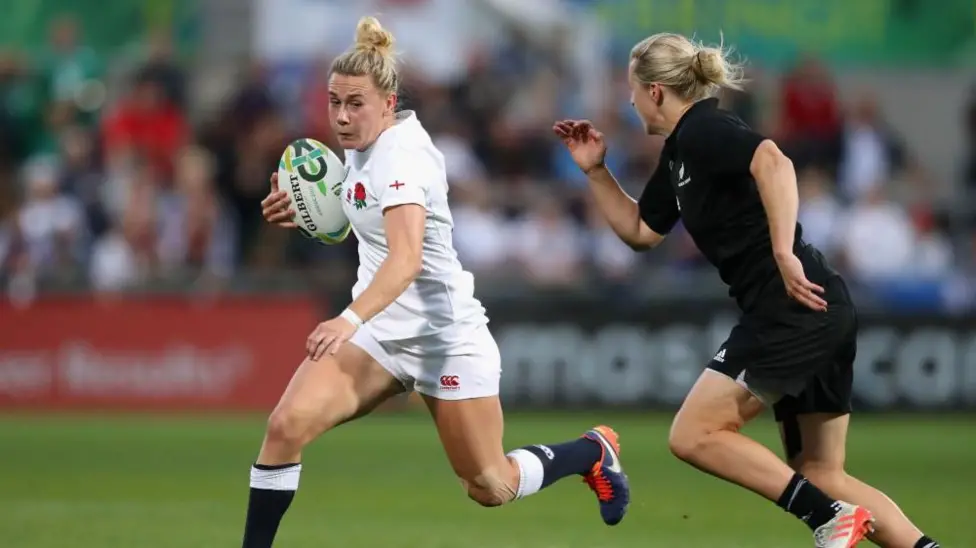
Meg Jones has been electric at this World Cup. Her speed, power, relentless work rate, and uncanny ability to appear exactly where her team needs her have made the England centre arguably the tournament’s standout player. But her rise has been anything but straightforward—shaped by resilience, sacrifice, and heartbreak.
During the early days of the Covid lockdown, Jones wasn’t dazzling crowds on the pitch. Instead, she was delivering packages in a high-vis vest as one of Amazon’s quickest drivers.
“I was so good—super fast. They even wanted to make a documentary about me,” Jones laughed on her Barely Rugby podcast. “But yeah, toilet breaks? Forget it. You’re in at 5am and you don’t leave until 4pm without even needing a wee.”
It was a surreal contrast. By then, at just 23, Jones had already reached a Rugby World Cup final in 2017, featured as a reserve at the Rio Olympics, and built a reputation as one of England’s brightest stars. Yet when her Sevens contract was frozen during the pandemic, she feared her rugby career might be finished.
“I thought I was going to be an Amazon delivery driver for the rest of my life,” she admitted. Online retail’s gain would have been English rugby’s devastating loss.
A Prodigy with a Plan
Born in Cardiff, Jones was introduced to rugby by her father, Simon, at just six years old. By 11, she was lifting trophies at the Principality Stadium. Playing a year up for Cardiff Blues’ under-15s, her talent was impossible to ignore.
“Her ball-playing was only eclipsed by her kicking,” one match report beamed.
England legend Danielle Waterman recalls spotting her as a teenager: “She was in a pink scrum cap, running the show. One of the most talented under-18 players I’d ever seen.”
Despite her Welsh roots—Welsh father, Welsh upbringing, and fluent in the language—Jones had mapped her path across the border. Hartpury College. Loughborough University. Then England. At just 18, she made her Test debut against New Zealand. Her rugby dream was unfolding exactly as planned.
Triumph Shadowed by Tragedy
Behind the scenes, though, life was far tougher. Jones’ mother, Paula, a senior nurse, struggled with alcoholism for over 20 years. Her father, Simon, was diagnosed with advanced lung cancer and died in August 2024—less than seven months after his diagnosis.
The grief hit Paula hard, triggering a downward spiral. As Jones recovered from a serious ankle injury, she cared for her mother—feeding her, bathing her, urging her towards recovery. For a time, it worked. Paula stayed sober, reconnected with family, and found glimpses of hope. But after Jones returned to her own life in Leicester, Paula relapsed. A hidden bottle of amaretto undid her progress. By December, she was gone.
In just four months, Jones had lost both parents.
“It never really finishes,” she reflected in March. “I’ll always think they’re there in the crowds. Sometimes I catch myself thinking I’ll see them soon. But when I’m on the pitch, it’s my safe haven. Nothing else matters there.”
Playing with Perspective
Today, Jones channels her grief into purpose. She is now a patron of The Living Room, a Welsh charity supporting those battling addiction. And on the field, she plays with a new kind of fearlessness.
“It’s the best rugby I’ve ever played,” she told The Guardian. “Because nothing is worse than losing my dad—my best mate, the rock of our family. Nothing can break me more than that.”
That perspective has fueled her brilliance. This week, she cried tears of joy as her teammates embraced her following her nomination for World Player of the Year.
Whatever happens on Saturday, there will be more tears. But compared with the pain Jones has endured off the field, they will only be droplets. For England’s warrior queen, rugby remains not just a career, but a sanctuary—and a stage where she continues to chase greatness through grief.