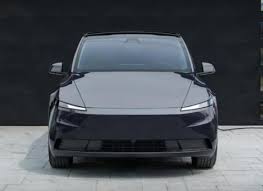
Remove the badge, cut the light strip, cancel the sunroof, bring back the manual steering wheel—wait, is this really a Tesla?
The much-anticipated “affordable” Tesla has finally arrived, yet consumers aren’t impressed. “It’s not an economy car,” some mocked, “it’s just an expensive tin can.”
Tesla officially unveiled the Model Y Standard and Model 3 Standard in North America, starting at $39,990 and $36,990 respectively—the cheapest Teslas ever.
But instead of excitement, the launch was met with disappointment. Consumers likened the cars to “bare shells” with stripped-down features and little value added.
On the day of release, Tesla’s stock plunged 4.45%, erasing $67 billion in market value overnight.
1. The Price-Cut Paradox
Price cuts have long been Tesla’s go-to weapon in fierce competition. But this time, the magic didn’t work.
The new models sacrificed too much—shorter range, no Autopilot, bare interiors. Buyers wanted “affordable innovation,” not “cheap simplification.”
Analysts noted that the Standard models are only $5,000 cheaper than the premium versions—hardly enough to offset the lost features. Meanwhile, Tesla’s profits are shrinking fast.
Revenue for the first half of 2025 fell 10.6% year-on-year, while net profit slumped 30%. Average profit per vehicle dropped to $5,700, down from $13,000 in 2021.
2. A Brand Under Pressure
Tesla was once the symbol of futuristic innovation. Now, it risks becoming just another automaker.
Frequent price cuts have eroded trust—many buyers are waiting for “the next discount” rather than buying now.
As investor Ross Gerber put it: “Tesla is starting to look more like Toyota than Mercedes.”
The real issue isn’t price—it’s stagnation. Without fresh innovation, even cheaper Teslas can’t inspire loyalty.
3. Musk’s High-Stakes Gamble
While the car division struggles, Elon Musk’s focus has shifted toward AI-driven ambitions.
Tesla’s Master Plan Part IV envisions an ecosystem of cars, robots, and energy—all powered by AI:
- FSD V14 pushes toward Level 4 autonomy.
- CyberCab driverless taxis begin trials in the U.S.
- Optimus humanoid robots aim for mass production by 2026.
For Musk, Tesla is no longer just about vehicles—it’s about redefining intelligence and mobility itself.
Yet, as innovation gives way to iteration, Tesla must rekindle the spirit that once made it great:
the courage to break boundaries, and the vision to lead, not follow.