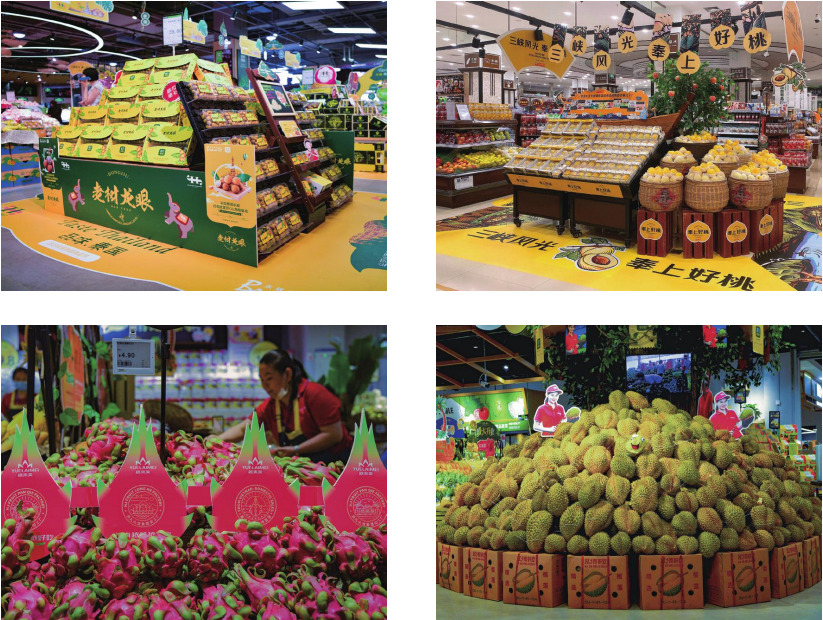
The “Durian King” didn’t escape the fate of delisting.
According to a recent notice from the Hong Kong Stock Exchange, Hongjiu Fruit failed to meet the resumption conditions within the required timeframe. On October 3, 2025, the Listing Committee decided to cancel its listing status. Although Hongjiu filed for a review on October 13, the decision was ultimately upheld, and its listing was officially cancelled at 9:00 a.m. on December 30, 2025.
What makes this even more striking is how quickly the story turned. It has been barely three years since Hongjiu went public—during which it once enjoyed peak glory, with a market cap surpassing HK$60 billion.
And Hongjiu isn’t the only “top student” in the fruit business running into trouble. Pagoda’s share price has been cut in half and its profits have slipped, while Xianfeng Fruit’s IPO ambitions have long since faded into silence.
So why does fruit—one of the most down-to-earth, trillion-yuan, everyday essential markets—look like a bottomless pit in the eyes of capital?
Hongjiu’s delisting is less an isolated accident than a classic cautionary tale, one that exposes the hard commercial ceiling hidden beneath the industry’s glossy surface.
A HK$60 Billion Market Cap Built on Receivables
Hongjiu didn’t fall because one or two fruit categories lost momentum. It fell because it tried to force agriculture’s long cycle to move at the “burn-cash” pace of the internet.
Founded in Chongqing in 2002 by Deng Hongjiu and his wife Jiang Zongying, Hongjiu Fruit grew as a traditional fruit supply chain and trading enterprise. Together with Pagoda and Xianfeng Fruit, it was often described as one of the “Big Three” in China’s fruit industry. And among them, Hongjiu moved fastest in the capital markets, listing on the Hong Kong Stock Exchange in September 2022, according to reporting by Yicai.
Yet just a year and a half later, in March 2024, the company’s shares were suspended for failing to publish financial results on time—a suspension that never ended. At the time, its auditor, KPMG, raised questions about a sudden surge of RMB 3.4 billion in prepayments in Q4 2023, including uncertainties about the identities of the payees and incomplete accounting documentation.
On top of the reporting issues, Hongjiu’s leadership also became entangled in legal trouble. In April 2025, founder Deng Hongjiu and several executives were placed under criminal compulsory measures on suspicion of loan fraud and issuing false VAT invoices.
That became the direct trigger for delisting.
But if we want to understand the real root cause, we can’t just stare at the broken funding chain. We have to return to the beginning—how Hongjiu gradually cornered itself with a strategy that looked powerful on the surface, yet was structurally fragile underneath.
Before listing, Hongjiu told the market a beautifully packaged story: “end-to-end.”
In this narrative, Hongjiu wasn’t merely a middleman—it was the coordinator of an entire system. It could harvest from orchards in Thailand and place fruit directly on shelves in China, cutting out intermediaries and delivering premium products like durian at more accessible prices. Lower prices would expand the market, scale would rise, and profits would follow.
It sounded like the perfect closed loop—a triumph of efficiency.
But strip away the glossy packaging, and the core starts to look far less like a fruit business and far more like a high-stakes financial arbitrage game.
To sustain the myth of ever-doubling revenue—and to keep the growth curve irresistibly “investor-friendly”—Hongjiu made a downstream compromise that violates the most basic rules of fresh produce: it began selling credit terms.
In traditional fruit wholesale, the norm is simple: pay and deliver, on the spot. Fruit doesn’t wait. Hongjiu broke that convention. It played the role of a generous banker and told downstream wholesalers: take the goods now, pay later.
In the short term, that generosity did drive explosive shipment volumes. Revenue climbed like a rocket.
But the price was brutal. A large, bleeding wound appeared in its financial statements. Read closely and you’ll see a stark contrast: the income statement looked vibrant, but the cash flow statement was already full of holes.
Because upstream, the rules are completely different—and far more unforgiving.
Thai durian orchard owners and Vietnamese dragon-fruit suppliers don’t care about your stock price. They don’t listen to your story. They don’t ship early just because your name is big. They only recognize cash. Want to lock in high-quality orchards? Pay real money months in advance.
That pushed Hongjiu into an extremely dangerous position.
On the left hand, it had to pour large amounts of cash upstream to secure supply.
On the right hand, it could only collect a stack of IOUs downstream—often six months long, or longer.
This was no longer “selling fruit.” It was using expensive funding to subsidize downstream turnover efficiency that was thin to begin with. The bet was simple: as long as scale expanded, and as long as financing never stopped, the game could keep going.
But Hongjiu wasn’t holding appreciating gold. It was holding fruit that rots.
That was the most fatal blind spot.
As Hongjiu pushed inventory aggressively downstream to inflate revenue, it was also overdrawing the market’s appetite. In fresh produce, time is measured in hours. The longer inventory sits, the faster value evaporates.
Once the funding chain tightened—even slightly—and payment cycles stretched, durians stuck in the channel quickly flipped from “assets” into liabilities, and sometimes into waste that cost money to dispose of. Those hundreds of billions in receivables: how much became bad debt because fruit spoiled and wholesalers refused to pay? Only the company—and perhaps the auditors—could know.
When auditors ultimately refused to sign off, and banks saw through the “borrow new to repay old” loop, collapse became inevitable.
Hongjiu didn’t just fail. It failed inside a very specific illusion: the belief that capital leverage could overpower agriculture’s natural rhythm. In the soil, cash flow will always outrank scale.
Agriculture Has No Foxconn: “Standard Fruit” Can’t Be Mass-Replicated
If Hongjiu’s tragedy was powered by financial leverage, then Pagoda and Xianfeng—both more focused on consumer experience and dense retail networks—reveal another kind of hardship: a structural dilemma that is hard to escape.
For years, chains like Pagoda have carried a grand ambition: turn fruit stores into the next McDonald’s.
They hoped to use industrial logic to reshape agriculture, building a standardized, endlessly replicable retail empire. But they underestimated how expensive the word “standardization” becomes in fresh produce.
Because the process of selecting “good fruit” is destined to be a cost disaster.
Take Pagoda’s signature grading approach as an example. It developed a quantified system called “Four Degrees, One Taste, One Safety,” grading fruit across dimensions such as sugar-acid balance, freshness, crispness, tenderness, aroma, and safety—then categorizing products into four levels: Signature, A, B, and C.
For consumers, this feels like a guarantee of quality.
For a business, it’s a punishing subtraction problem.
Agriculture is not manufacturing. On the same tree, uneven quality is the norm. To secure the top 20% that meets “Signature” standards, the supply chain must remove the remaining 80% at the source.
Where does that 80% go?
Even if it never reaches the store, its cost doesn’t vanish—it gets piled onto the 20% that does. In the era of consumption upgrading, the middle class was willing to pay the premium.
But in today’s more cost-conscious environment, those hidden costs have become harder to pass on to consumers with tightening wallets. What once supported the brand’s “high-end” positioning can quickly turn into an unsustainable burden.
At the same time, the relationship between brands and franchisees can slide into a risky zero-sum game.
When people admire chains with thousands of stores, they often overlook how fragile the unit economics can be. Fruit retail depends heavily on fast turnover. Rent, labor, utilities, and cold-chain expenses are fixed, and only extremely high productivity per square meter can cover them.
For the brand, profits largely come from supply chain margins on fruit sold to franchisees, plus franchise fees.
For franchisees, profits come only from the thin retail margin on fruit itself.
That creates a built-in conflict of interest: the brand wants franchisees to purchase more—and purchase higher-priced products—to maintain brand image and supply-chain throughput. Franchisees, trying to survive, must squeeze every cent.
And unlike standardized consumer goods such as liquor—where inventory stocking can sometimes “smooth” performance—fruit simply doesn’t behave the same way. It expires.
This is why stories about “passing off inferior fruit,” or “cutting fruit plates to deal with spoiled inventory,” keep resurfacing. At its core, it’s not only an ethics issue. It’s a survival issue.
When foot traffic drops and turnover slows, franchisees who can’t move fruit before it goes bad face one outcome: loss and closure. This structural tension means the larger the chain grows, the harder it becomes to manage—and the risk of brand trust collapse rises exponentially.
Finally, the most direct and decisive blow: middle-class “fruit faith” cracked under economic downshifts.
In recent years, Pagoda and Xianfeng benefited from a fragile middle-class illusion—where imported cherries or beautifully packaged strawberries symbolized a better life. That psychological account of “fruit freedom” supported premium pricing.
Then came Pinduoduo, Meituan Youxuan, and community group buying, shattering the myth.
Their aggressive next-day delivery models reduce inventory risk through pre-sale mechanisms and push down source prices through centralized procurement. When consumers realize they can buy bananas for RMB 3 per jin via group buying—slightly worse in taste, perhaps, but a fraction of the price—the “quality lifestyle” filter breaks.
Fruit isn’t Hermès. It’s still an agricultural product.
Once “value for money” replaces “self-indulgence” as the mainstream consumption logic, premium fruit chains in upscale neighborhoods—beautifully designed, service-oriented, and expensive—suddenly find themselves trapped:
They can’t beat internet giants on price.
They can’t beat the neighborhood mom-and-pop shop on convenience.
What once looked like a moat now resembles an island that slowly isolates them.
Closing Thoughts
Hongjiu’s delisting, alongside Pagoda and Xianfeng’s slowdown, may be the moment to pause and reassess this business.
Together, these three cases deliver an extraordinarily expensive lesson to every investor trying to “upgrade” traditional agriculture: there is no quick money here, and there are no miracles.
This is a weather-dependent, non-standardized, high-loss, low-margin industry—one that naturally resists the internet-style fantasy of explosive growth. For years, the market worshipped “scale effects” and “capital leverage,” believing that burning cash could buy market share, and market share could eventually turn into profits—believing that running fast enough could ignore gravity.
Reality proved otherwise.
When you plant in the soil, you have to obey the soil’s laws.
The real way forward may not be about who runs fastest or expands widest, but about who can truly settle in—build deeper supply chain capabilities, reduce spoilage to the lowest possible level, and deliver stable quality with disciplined operations.
The gong of the Hong Kong listing once made Hongjiu believe it had crossed the gate of destiny.
In the end, it was pulled back into the dirt.
And in this industry, “slow” may be the fastest road of all.