(Bentonville, Jan 29)
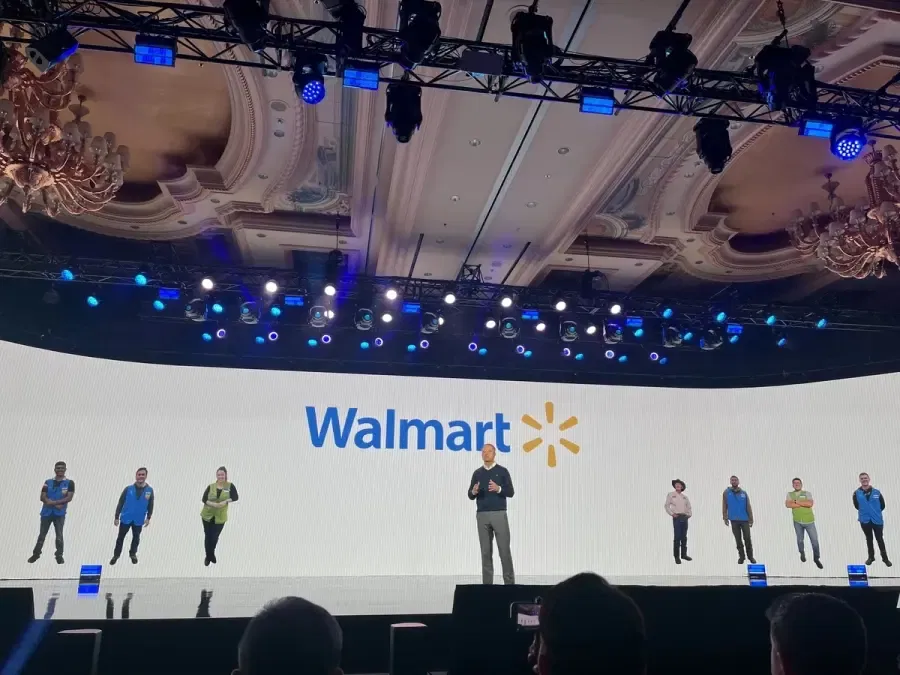
Walmart announced that it will officially move its primary stock listing from the New York Stock Exchange to Nasdaq on December 9, 2025. While the decision may appear technical, markets widely view it as a strategic shift in corporate identity and valuation logic. The move is seen as Walmart’s attempt to break free from its long-standing image as a traditional big-box retailer and reposition itself as a technology-driven company for its next phase of growth.
While listed on the NYSE, Walmart was typically categorized as a consumer staples stock, trading at price-to-earnings multiples of around 20–25x, reflecting conservative expectations for traditional retail growth. Following the switch to Nasdaq, however, investors have increasingly applied a tech-style valuation framework, with the company’s P/E ratio climbing toward 40x. Analysts argue this is less about venue and more about a deliberate effort to redefine how Walmart is perceived by the market.
Traditional supermarkets face a structural decline
In contrast, the broader U.S. supermarket industry is entering what many describe as a period of collective decline. Kroger, another industry leader, saw its planned $24.6 billion acquisition of Albertsons blocked on antitrust grounds, forcing it to abandon both the deal and associated store divestment plans.
As a result, Kroger has shifted from strategic restructuring to defensive retrenchment, announcing plans to close around 60 stores over 18 months and record $100 million in asset impairments. Albertsons, having lost its merger lifeline, now faces high labor costs, intense price competition from Walmart, and a looming $600 million debt maturity in 2026, while shuttering underperforming locations.
With companies such as Joann Fabrics filing for bankruptcy and Rite Aid closing hundreds of stores, mid-sized U.S. retailers are rapidly exiting the market. Analysts point to scale, data, and technology as the decisive factors: Walmart’s massive purchasing power, AI-driven supply chain, and highly automated logistics enable it to price at levels competitors struggle to match, while rivals lag in automation investment and digital transformation.
Transformation driven by execution, not slogans
Walmart’s transformation is rooted in execution. More than half of its online orders are now fulfilled through automated facilities, and over 40% of new code is generated or assisted by AI. The company continues to recruit engineering talent and deploy AI agents capable of automating complex workflows. Management has stated that while total headcount may remain broadly flat over the next three years, the nature of work will fundamentally change.
In early 2026, Walmart completed a key leadership reshuffle, appointing former Amazon executive David Guggina to oversee U.S. operations and naming retail veteran John Furner as CEO to lead AI integration and organizational change. Under this leadership, Walmart achieved a milestone in the first quarter of fiscal 2026, with both U.S. and global e-commerce operations turning profitable simultaneously.
According to the CFO, profitability hinges on delivery density and speed. Walmart can now deliver to 95% of U.S. households within three hours, leveraging store-based fulfillment and automation to cut unit costs. As a result, U.S. e-commerce losses fell by 80% year-on-year in 2025.
Growing technology out of retail
Symbolically, Walmart joined the Nasdaq-100 index on January 20, 2026, replacing AstraZeneca, marking its entry into the core universe of global tech investors. As its digital, AI, and e-commerce capabilities deepen, Walmart’s market capitalization briefly surpassed $1 trillion, prompting comparisons with Amazon rather than traditional grocery peers.
Walmart’s unique advantage lies in its real-world data. With roughly 240 million customers each week purchasing high-frequency essentials across online and offline channels, the company has built a closed-loop demand data system reflecting what consumers need now—not what they might want later. This data underpins dynamic pricing, inventory replenishment, and personalized engagement.
Analysts summarize the distinction succinctly: Amazon used technology to grow into retail, while Walmart is using retail to grow into technology. Going forward, U.S. retail may be dominated by just two archetypes—the cloud-and-algorithm model of Amazon, and Walmart’s physical-demand-led platform strategy—leaving little room for a viable third path.