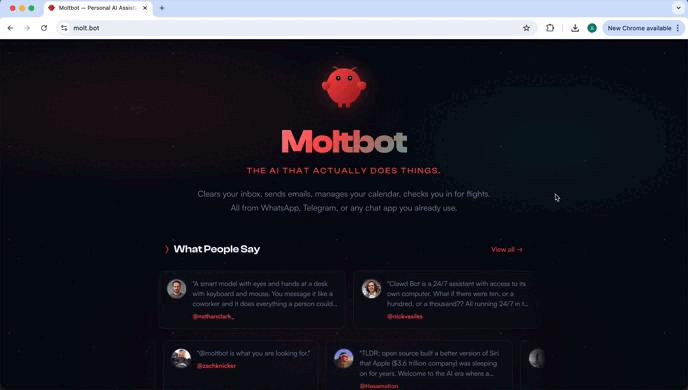
In January 2026, an open-source project called Clawdbot (now renamed Moltbot) exploded in popularity, racking up over 99,700 stars on GitHub and triggering exponential discussions on Discord and X. The community jokingly calls it a “Jarvis living inside your computer.”
Clawdbot runs locally on your Mac or server and interacts via familiar chat apps like Slack, Teams, iMessage, or Telegram. It can directly manipulate local files, terminals, and even browsers. Upon receiving commands, it autonomously operates your machine—turning tens of thousands of Macs and PCs into remotely controllable digital avatars in just a few days.
Despite its technical fame and attention from investors and tech giants, experts agree: “Currently, Clawdbot has no commercial value.” Peter Steinberger, its creator, admits: “It’s not a company product; it’s just something I tinkered with at home.”
1. Why Clawdbot Went Viral
At its core, Clawdbot bridges cloud intelligence and local systems. Its recursive skill-evolution mechanism allows it to autonomously write code, debug locally, and package successful attempts into SKILL.md files. This enables the AI to build “muscle memory” through trial and error, much like a human apprentice.
As an Action-Oriented Agent, Clawdbot executes tasks in real file systems and networks by impersonating the user, simply through chat commands. On social media, users showcase its astonishing achievements while running in the background—it may quietly learn or subtly alter your bank records.
The key innovation lies in orchestrating complex workflows safely, ensuring commands execute precisely without crashing the system. Yet, from a commercialization standpoint, it’s only about 20% of the way there.
The ecosystem and user experience also contributed to its viral spread. By connecting via chat apps, users can interact asynchronously, while Codex subscription support keeps operational costs manageable.
2. Security Challenges Outweigh Development
High privileges make Clawdbot powerful—and risky. Three major security concerns are:
- Indirect Prompt Injection: Malicious instructions hidden in emails or social messages can be executed by the AI.
- Skill Supply Chain Vulnerabilities: Community-shared skills may contain hidden backdoors that exfiltrate API keys.
- Exposure & Authentication Risks: Some users expose control endpoints to the public internet, making them easy targets.
These challenges are not easy to solve. There’s a tradeoff between productivity and security: AI needs high privileges to be effective, but sandboxing limits functionality.
3. A Lesson for AI PCs
Traditional AI PC features mostly enhance knowledge search or file semantic queries, rarely performing real cross-application operations. Clawdbot demonstrates a new paradigm: it glues tools together while hiding technical details, making interactions as natural as chatting with a friend.
As Peter notes: “The code itself isn’t valuable. What matters is the idea, the attention, and the brand.” Clawdbot’s significance lies not in commercial value but in inspiring the industry with new paradigms, pressures, and motivation. AI PCs that don’t open their ecosystems risk obsolescence, while projects like Clawdbot accelerate the growth of the Agent economy and innovation wave.