Since 2025, the short-form drama industry’s traffic dividend has begun to plateau. While the entire sector is still searching for breakout hits beyond its core audience, an inevitable market segmentation is also taking shape. More production teams are no longer chasing big budgets and “premium” positioning—instead, they are turning to the lower-tier market to find fresh opportunities.
These “lower-tier dramas” primarily target rural towns and fourth- and fifth-tier cities, with middle-aged and older viewers as the core audience. Budgets are compressed dramatically, with single-series costs typically falling into the RMB 100,000–300,000 range.
This downward shift is driven by two forces. First, short dramas still need new user growth. Beyond premium productions that aim upward for wider recognition, the lower-tier market remains far from fully tapped. Second, the head effect is becoming more pronounced: profit margins for mid-tier and newer producers are being squeezed, forcing them to find alternative survival paths.
Recent breakout titles such as A Good, Well-Behaved Girl, Eighteen-Year-Old Great-Grandma Arrives to Restore the Family’s Glory, and Midsummer Fendela have repeatedly shattered viewership records. Yet for the majority of producers—those without deep funding or strong content capabilities—the premium track has become a high-investment, high-risk gamble. As platforms reduce minimum guarantees, many small teams are left with fewer safety nets and greater downside exposure.
Against this backdrop, lower-tier short dramas—previously overlooked—are revealing a distinctive competitiveness. They offer access to a less saturated market, lower production difficulty, reduced investment risk, and a more predictable path to cash recovery.
Operationally, lower-tier short dramas have pushed cost reduction and efficiency to an almost fully industrialized extreme. Teams cut crew sizes aggressively, avoid expensive “in-ranking” influencers and stars, compress filming into two or three intense days, and shoot multiple series back-to-back or in overlapping “package” production formats. AI is also increasingly involved in script generation. Through these methods, single-series budgets are driven down to the RMB 200,000–300,000 level—or even close to RMB 100,000.
Chasing New Growth in the Lower-Tier Market
Data from the DataEye Hongguo Monthly Hot List (November) shows Eighteen-Year-Old Great-Grandma Arrives to Restore the Family’s Glory (Part 3) taking the top spot. The producer Tinghuadao placed four titles in the top ten, underscoring the strengthening “winner-takes-more” dynamic.
For mid-tier players and new entrants, competing with top studios across IP resources, production systems, and actor pipelines is increasingly unrealistic. On the premium side, the number of productions costing over RMB 1 million per series has clearly risen since 2025. At the top end, “S-tier” projects can cost RMB 1.5–3 million per series, and blockbuster titles like Midsummer Fendela and Home and Away 2 can exceed even that.
Without a solid capital base, it’s difficult to match the content quality and spending power of premium leaders. Starting in the second half of 2025, more short drama companies began repositioning—seeking new markets and defensible niches.
Dafang Mutual Entertainment, a Zhengzhou-based studio founded in 2024 with a team of over 100 people, began shifting its focus to the lower-tier market in the second half of last year. Business manager Li Runzhe put it bluntly: “Premium short dramas are already very mature. We can’t out-compete them by grinding harder.”
In fact, Dafang originally aimed for the premium route. During the high-growth phase two years ago, platform minimum guarantees were substantial—Li said they could reach “as high as RMB 500,000.” But around September last year, guarantees “dropped sharply,” pushing far more risk onto producers.
He cited a painful example: a premium female-oriented series launched in May 2025 with a RMB 600,000 budget. The team had high expectations, but it ultimately generated just over RMB 100,000 in returns. “Even setting aside production and team capabilities, premium dramas carry higher risk than lower-tier dramas,” he noted. As a result, for 2026 the company plans to allocate two-thirds of its capital to lower-tier projects, focusing on original content and building its own rights library.
Similar logic is reshaping decisions across the industry. “Gangzi” (pseudonym) co-founded Henan Yun Ye Ting Feng Film & Television in September last year. Meanwhile, Zhang Lai established the New Energy Fenghua Short Drama Dream Factory in Zhejiang in late December. Both have pivoted to producing lower-tier dramas.
Gangzi explained that premium markets demand heavy specialization: “Female-oriented premium dramas are mainly a war of actors, while male-oriented premium dramas require strong script R&D.” The former inflates costs, and the latter can require two to three months of development—factors that pushed them to seek opportunities in the lower-tier segment.
Even though the lower-tier market includes high-output players—such as Riyue Xin Yi (reportedly producing 200–300 titles per month) and Mile Network (around 500 titles annually)—many practitioners still perceive competition as relatively manageable. Zhang Lai described it this way: “It’s not really a race between companies, because lower-tier returns don’t produce that many myths. It’s more a stable entry point for smaller teams to build a track record, secure more projects, and attract investment.”
A New Market, a Smaller Business, and Steadier Returns
Objectively, many producers are being pushed downward by market pressure, but the mood is not as pessimistic as outsiders might expect. The lower-tier segment—by differentiating itself from premium dramas—has its own clear advantages.
The first advantage is cost: lower budgets significantly reduce investment risk. Premium series often start above RMB 500,000, while lower-tier productions can be controlled at RMB 300,000, RMB 200,000, or even RMB 100,000.
Zhang Lai framed the investment logic: “Instead of betting RMB 500,000–600,000 on one premium series and hoping for a blockbuster, I’d rather invest in ten RMB 100,000 lower-tier series.” By scaling volume, the probability and stability of cash recovery and profit can exceed the single premium bet. In her experience, “seven out of ten” can break even or turn a profit, while mid-tier premium projects are more likely to flop. “For investors, putting RMB 200,000–300,000 into a premium mid-tier project can feel like an all-in. Lower-tier investing is a different mindset.”
On returns, Li Runzhe estimated that a RMB 200,000 lower-tier series typically earns RMB 40,000–100,000 in profit (roughly 20%–50%). Zhang Lai added that a batch investment of ten series (RMB 1 million total cost) can deliver 20%–30% overall profit under conservative conditions, and in strong cases may return RMB 2 million or more. The upside may not match premium breakouts, but the key advantage is steady cash flow.
Second is audience scale. As an emerging growth pocket, the lower-tier market has a massive, stable, and not-yet-saturated user base. It captures groups often excluded by traditional long dramas and premium short dramas—middle-aged and older viewers in third- to fifth-tier cities, as well as security guards, domestic helpers, caregivers, delivery riders, and construction workers.
The older demographic is particularly attractive: they typically have more leisure time, stronger willingness to respond to advertising, and are less affected by piracy. This group is also growing. According to Ministry of Civil Affairs data, at the beginning of 2025 China’s population aged 60+ reached 310 million—about 22% of the total—and is projected to keep rising rapidly over the next decade by more than 10 million per year.
For many content businesses, the “silver economy” is no longer theoretical—it’s a real market. Li Runzhe, Zhang Lai, and Gangzi all expressed confidence in the segment’s long-term potential.
This downward logic also translates overseas. Compared with the current mainstream export markets for short dramas—Japan, South Korea, Europe, and the U.S.—Southeast Asia sits closer to the “lower-tier” end in terms of consumption patterns. Dafang experimented with both Western and Southeast Asian expansion, and ultimately found smoother traction in Southeast Asia. As Li put it, “In education levels and overall development, many Southeast Asian countries resemble China 20 years ago, so they accept lower-tier content more easily.”
He also noted that overseas ad rates can be significantly higher: in China a single ad unit may earn RMB 0.8–5, while overseas “the minimum is about US$2 per unit,” roughly seven times higher. Content localization often requires primarily language translation rather than structural rewriting.
As producers shift markets, the creative logic changes—and production difficulty drops. For middle-aged and older viewers, the bar is not “film-level” storytelling or the nuanced emotional tension of titles like Midsummer Fendela. What matters is direct emotion and a complete, easy-to-follow story.
In practice, lower-tier dramas need either an immediately satisfying emotional payoff, or a long buildup that releases everything at the end. Popular themes include rural life, conflicts between mothers-in-law and daughters-in-law, countryside suspense, and “middle-aged CEO” storylines.
For producers, the lowered creative threshold also makes original IP more feasible. Owning rights enables flexible distribution across multiple channels such as Taobao, Pinduoduo, and Hemma, strengthening both bargaining power and profit stability.
Li said Dafang currently collaborates frequently with Duoduo Short Dramas because traffic incentives and follow-on revenue are higher. Overall, he explained, selling rights to platforms like Jiuzhou and Hemma can work even if only one platform shows strong data: “Once a single platform performs well, costs can be recovered. And selling playback rights or first-release rights already brings back close to half of the investment.”
Multi-channel distribution is supported not only by business logic, but also by clear demand signals and platform direction. At the base level, the short drama market still needs user acquisition: one path pushes premium content upward for broader reach, while the other digs deeper into lower-tier audiences. Both new and established platforms are actively exploring these two directions.
Last July, ByteDance launched a new short drama app—Muye Free Short Dramas—alongside Hongguo, initially releasing only through vivo and Xiaomi app stores. Meanwhile, Dianzhong’s free short drama app Hemma Theater has maintained strong growth. QuestMobile’s 2025 China Mobile Internet Autumn Report (September) reported Hemma Theater’s monthly active users exceeding 50 million, up 99.4% year-on-year.
At the same time, e-commerce platforms such as Pinduoduo—represented by Duoduo Video—have shown strong demand for short dramas as they push deeper into content. Their massive user bases also provide powerful traffic entry points. Last July, Duoduo Video upgraded its co-creation plan, including policies such as “the platform co-invests 50% of production costs,” helping reduce risk for producers.
The Extreme “Cut Costs, Speed Up” Playbook
As more producers move into the lower-tier segment, a streamlined and high-efficiency production logic is forming—both in filming and in scripts. Zhang Lai told New Voice Pro that she began feeling the shift after September 2025.
On set, reaching RMB 300,000, RMB 200,000, or even RMB 100,000 budgets depends on multiple levers.
The biggest cut is actor fees. Premium productions often rely on traffic stars costing RMB 10,000–20,000 per day (or more) to “stabilize” performance. Lower-tier dramas don’t require stars.
Gangzi explained: “We don’t need massive traffic. We need actors with solid acting ability. Lead actors might cost around RMB 2,000–5,000 per day.” With a roughly one-week shoot, “you can save RMB 100,000 just on actors.” As a result, lower-tier crews often partner with schools and local communities to recruit lower-cost non-professional actors and staff.
Wardrobe, makeup, props, and locations are also simplified—sometimes avoided at the script stage. Many rural stories can be filmed in very limited spaces: “Some scenes can be done in a single room,” or within one base that can provide everyday settings like streets, hotels, and clinics. Visual quality standards are typically less demanding than premium productions.
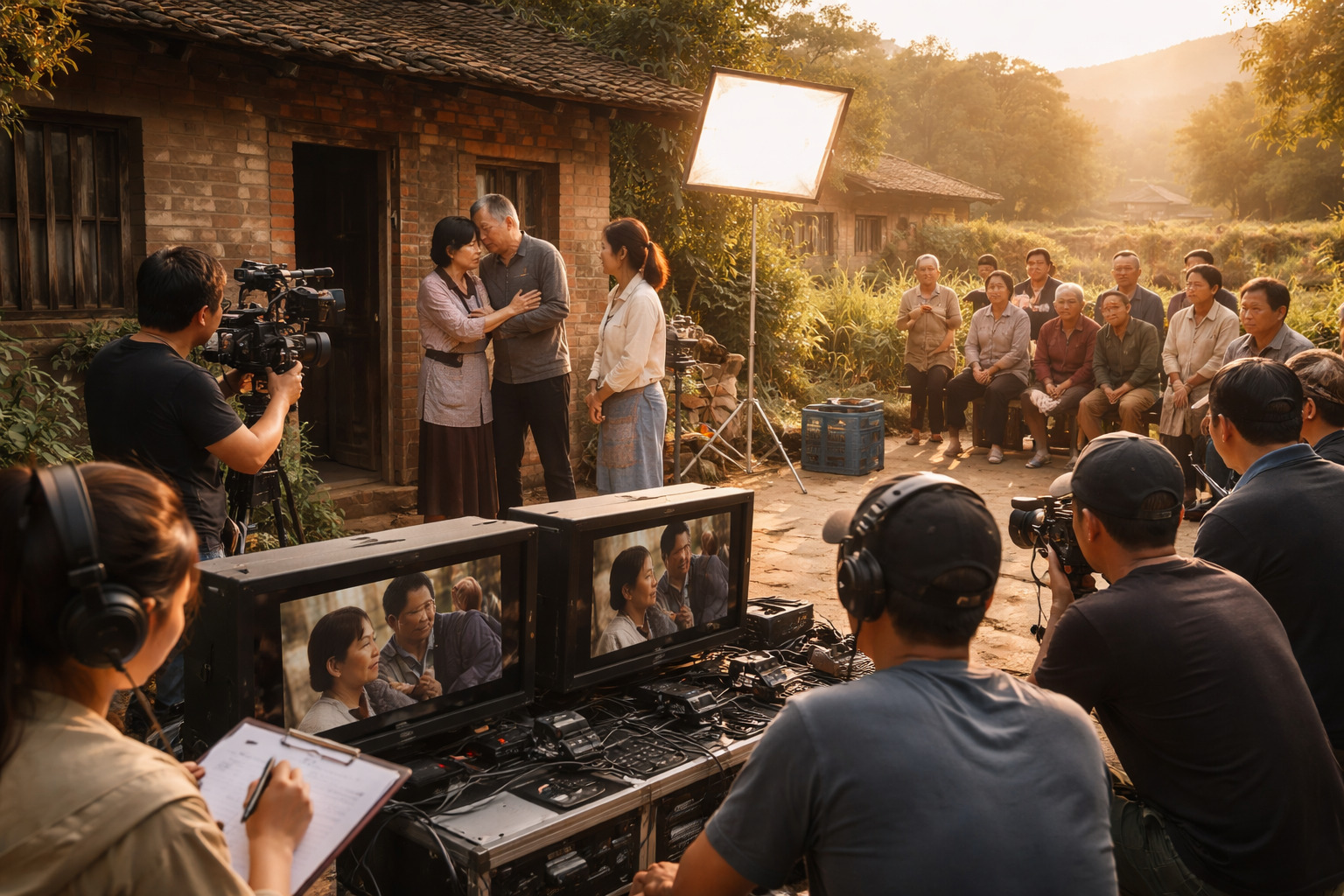
Team size shrinks accordingly. Premium crews often require 40–50 staff, while lower-tier crews may drop to 30, 20, or even 10 people. Roles such as producers, assistant directors, and styling assistants are reduced; casting may be handled directly by a producer; expensive lighting is cut; and “no live sound on set—everything is dubbed in post” becomes common.
For ultra-lower-tier productions around RMB 100,000, cuts can be even more aggressive: a single producer covers multiple functions, actors handle their own base makeup, and the director may double as an all-around executor for cinematography and props.
With these reductions, pre-production can shrink to roughly one week, and filming can also be compressed into about one week. Zhang Lai described the most intense scenario: shooting an entire series in two to three days, where core staff may work 48–72 hours without rest, and waiting actors sleep directly on set.
To further spread costs, Zhejiang crews have increasingly adopted “continuous shooting” and “package shooting”—filming multiple series, sometimes more than ten, in a single run to reduce average spending on staffing, locations, and equipment.
Li said Dafang plans to try this after Spring Festival: “We’re planning a ten-series continuous shoot, with three crews filming in parallel.” The goal is straightforward: reduce costs. “Renting equipment for seven days versus a month can be a huge difference. If one series gets a 10% discount and saves RMB 10,000, across ten series you’re saving well over RMB 100,000.”
Scripts are being compressed too, and a clear trend is AI’s deep involvement in writing. In many cases, humans provide the story outline and episode breakdown, while AI generates the detailed scene progression. Industry-wide, much of the “core creativity” is also being derived from market patterns—sometimes drifting into imitation and rewrites.
As mentioned earlier, many lower-tier producers prefer original scripts over buying IP. IP adaptation scripts typically cost RMB 30,000–60,000, while original scripts can be as low as RMB 10,000–20,000—or even RMB 3,000–5,000.
Zhang Lai added that AI is now cutting costs beyond scripts: “A lot of short dramas even use AI-generated posters. Saving RMB 1,000 can cover the crew’s meals.”