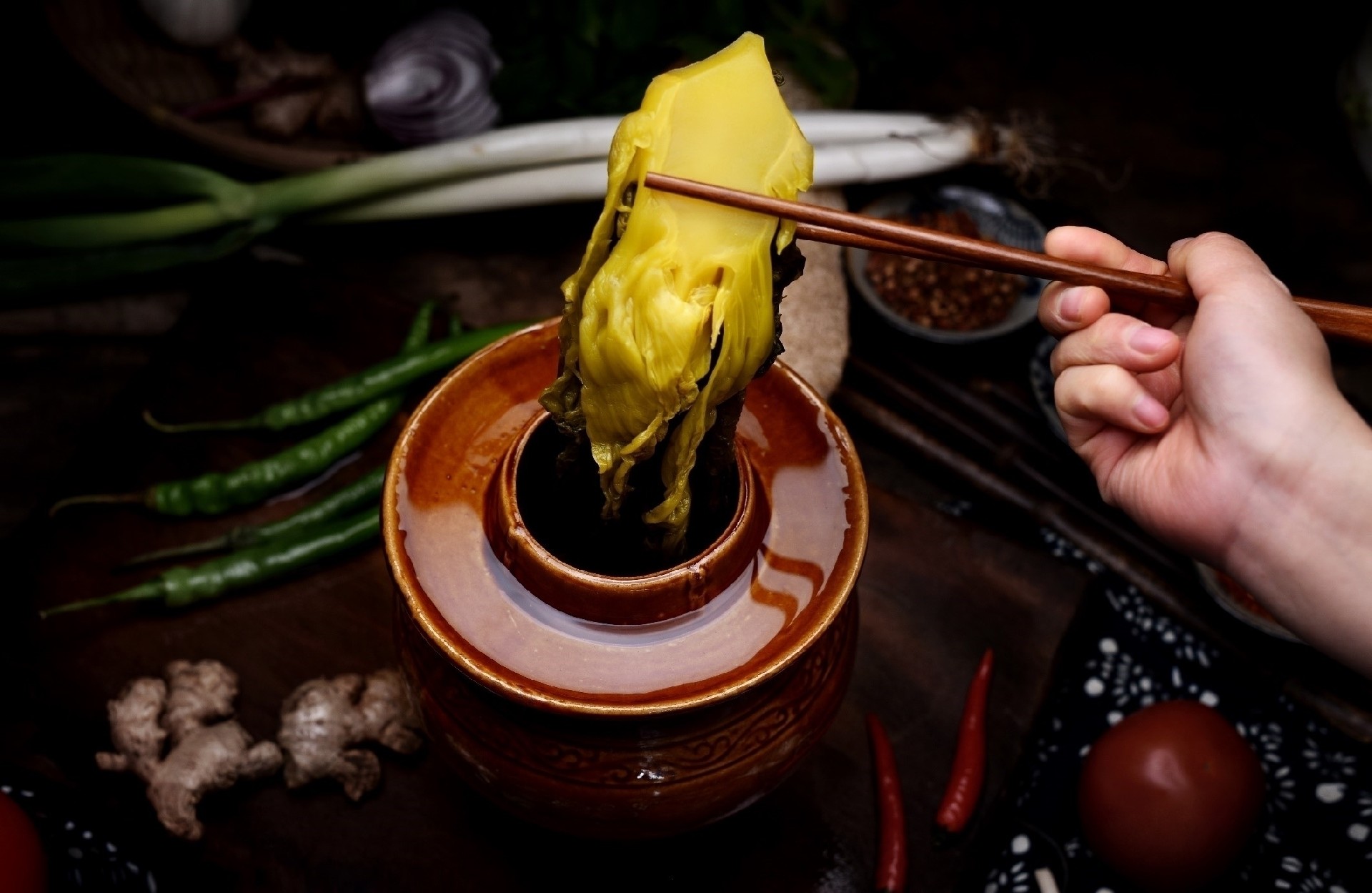
Braised beef sauce, crunchy long beans, tender mustard greens—savory, salty, and boldly spicy, these humble jars of “rice companions” have long graced countless family tables across China. Now, this beloved national comfort food is on the verge of changing hands.
Investment Circle has learned that Chongqing’s Market Regulation Administration recently published a public notice: FountainVest Capital Partners GP4 Ltd. (“FountainVest GP4”) will acquire a 92% stake in Jixiangju through its wholly owned subsidiary, Chuanxiang Siyi. Tracing the transaction through, the buyer is none other than FountainVest Capital.
There’s an old saying: “When it comes to Chinese pickles, look to Sichuan.” Founded in Meishan—hometown of Su Dongpo—Jixiangju began as a small pickle-processing factory built by Ding Wenjun. From there, he turned crisp, flavorful side dishes into a national favorite. As early as 2020, the company entered IPO counseling, yet substantive progress never materialized.
After years of twists and turns, Jixiangju has chosen a new path: selling the company.
More deal details have since emerged.
Before the transaction, founder Ding Wenjun held 31.24% of Jixiangju and exercised sole control. After the deal closes, FountainVest GP4 will indirectly control 92% of the company’s equity, becoming its single controlling shareholder.
As a leading player in the pickled-vegetable segment, Jixiangju has long been viewed as the brand most likely to challenge Fuling Zhacai. Public disclosures show that Jixiangju holds a 0–5% share in both China’s pickled vegetable and compound condiment markets—placing it firmly among the industry’s top tier.
Behind the scenes, Ding Wenjun once set a bold “Double Hundred” vision in 2023: first, to lead the company to a public listing within three to five years; second, to reach RMB 5 billion in sales within five to ten years.
That ambition helps explain the investment logic now taking shape. In a highly fragmented niche, companies like Jixiangju may not be absolute giants, but they are high-quality, highly malleable assets—exactly the kind private equity firms favor for value creation through capital injection, management optimization, and resource integration.
For FountainVest Capital, the buyer in this deal, acquisitions are familiar territory.
Founded in 2007, FountainVest describes itself as one of Asia’s leading independent private equity firms, with a focus on consumer, media and technology, healthcare, industrials, and financial services. Its most high-profile investment in recent years was Amer Sports, the parent company of Arc’teryx.
Amer Sports owns premium brands including Arc’teryx, Salomon, Wilson, and Atomic. In 2018, FountainVest joined forces with Anta Sports, Chip Wilson’s Anamered Investments, and Tencent to acquire Amer Sports for €4.6 billion (about RMB 36 billion at the time), marking the largest overseas acquisition by Chinese capital that year.
More recently, FountainVest was also among the institutions that submitted binding bids during last year’s sale of Starbucks’ China equity.
From Meishan to the world: how a national staple was made
There’s a saying in the industry: “Chinese pickles look to Sichuan; Sichuan pickles look to Meishan.”
Known as a “rice companion,” pickles are an inseparable part of the Chinese dining table. What many don’t realize is that Meishan—also the hometown of Su Dongpo—is widely regarded as the cradle of Chinese pickles, producing roughly one-third of the country’s output. Jixiangju is one of the legends born there.
The story begins with a young man from rural Sichuan.
Born in the countryside of Meishan, Ding Wenjun was bold and strong-willed from an early age. At just 17, he hauled more than 200 kilograms of vegetables on his bike to sell in Chengdu, earning his first pot of gold. He soon moved into food trading in Guizhou, where he quickly rose to the top among local peers.
A chance encounter changed everything. Witnessing unsold vegetables piling up in his hometown, Ding spotted an opportunity. In 2001, he invested all his savings—over RMB 1.5 million—to found Jixiangju and open its first pickle-processing plant.
At the time, second- and third-tier city markets were largely untapped. Seizing the moment, Ding pushed in aggressively, and from 2009 onward, sales grew at an annual rate exceeding 40%. The industry standards for packaged pickles that consumers enjoy today were, in fact, first drafted and implemented by Jixiangju.
“I have a habit—whenever I visit a country, I go to the local supermarket to see if they sell Jixiangju pickles,” Ding once told the media. Having quietly become a hidden giant, Jixiangju now exports to more than 20 countries and regions, including Japan, the United States, the UK, Singapore, and South Korea.
Today, the company has built a brand portfolio that includes Jixiangju, Bao Xiafan, Jiang Niu Bafang, and Chuanzhimei. Its product range has expanded from a single pickle line to over 100 SKUs spanning pickled side dishes, sauces, and compound seasonings. Crisp, refreshing, and comforting, these products have become a cherished staple in the national memory.
Capital ties, long in the making
Jixiangju’s relationship with capital dates back many years.
Equity records show that at inception, Ding Wenjun held 30%, Li Wenxue 20%, and Wu Xueming, Wu Chaoqun, and Wu Chaoquan held 17%, 17%, and 16%, respectively. Among them, Wu Chaoqun is the controlling shareholder of Qianhe Condiment, making Jixiangju once an affiliated company of Qianhe.
In 2011, after two rounds of equity transfers, the Wu brothers exited entirely. Around the same time, South Korea’s CJ CheilJedang entered as a shareholder. CJ later increased its investment, but in July 2023 chose to exit, selling all its shares to Sequoia, Tencent, and Jixiangju’s management team.
In 2020, Jixiangju signed an IPO counseling agreement with Huaxing Securities and initiated plans to list on ChiNext under the registration-based system. The following year, it switched sponsors to Minsheng Securities and completed filing with the Sichuan regulator.
More than five years into the process, the road to listing proved long and arduous. Now, the company has opted for a different destination.
Some exit, others step in: China’s consumer M&A wave
Over the past year, a wave of consolidation has swept through China’s consumer sector.
The most eye-catching episode was the fierce private equity bidding war for Starbucks China. In the end, Boyu Capital acquired a 60% stake for a total valuation of USD 4 billion, forming a new joint venture while Starbucks retained its brand and intellectual property.
Behind the sale lay mounting pressure. Intensifying competition from Luckin Coffee, Cotti Coffee, and rapidly expanding tea brands—many employing aggressive low-price strategies—has made life increasingly challenging for Starbucks China, prompting it to seek a stronger local partner.
Last July, national soda brand Dayao was also rumored to have been acquired by KKR. Originating from the former Bayi Beverage Factory in Inner Mongolia, Dayao is a nostalgic icon for a generation. Amid a broader downturn in carbonated drinks, selling to KKR became a calculated choice.
Similar stories continue to unfold: DCP Capital acquiring RT-Mart’s parent company Sun Art Retail; FountainVest partnering with Unison Capital to buy Japanese luxury jeweler Tasaki; L Catterton taking a majority stake in Nordic personal care brand STENDERS.
A common thread runs through these targets. Most enjoy solid brand recognition and leadership in niche segments, yet face growth headwinds amid shifting market conditions. At such moments, private equity firms increasingly move beyond minority financial investments toward control-oriented buyouts, stepping in to help drive transformation.
As FountainVest partner Li Zhen once observed, many Chinese industries remain highly fragmented. Helping companies sharpen strategic focus, improve efficiency, and strengthen fundamentals is precisely where buyout funds excel.
In that sense, this is a reflection of changing times.
“A decade ago, the economy was growing at high speed, and entrepreneurs’ expectations were sky-high—good projects were hard to find,” Li noted. “Today, as supply-side transformation deepens, more companies encounter challenges and are increasingly willing to entrust their businesses to capable buyout funds.”
For private equity, these moments present opportunity. Consumer sectors, long viewed as resilient and relatively countercyclical, often become even more attractive amid economic volatility.
Some step away, others step in. As one chapter closes, another quietly begins.