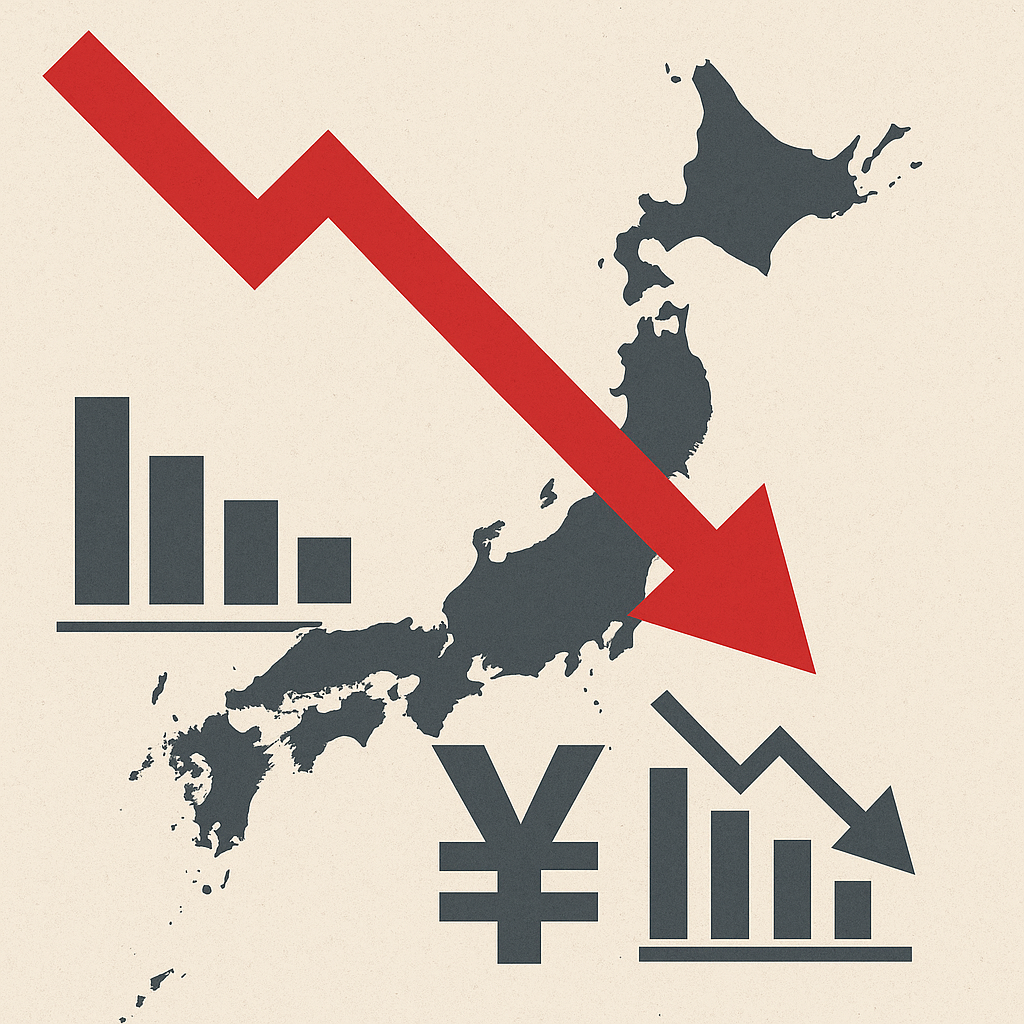
Japan’s economy unexpectedly contracted in the first quarter of 2025, even though the full impact of tariff shocks has yet to be realized. According to data released by Japan’s Cabinet Office on May 16, real GDP fell by 0.2% quarter-on-quarter and declined 0.7% annually, far exceeding the market expectation of a 0.2% drop. This marks the first quarter of negative growth in four consecutive quarters.
The main drivers of the economic decline were stagnant private consumption and declining exports. Private consumption, which accounts for over half of Japan’s economic output, was flat in Q1, missing the expected 0.1% growth. Meanwhile, exports dropped 0.6% quarter-on-quarter while imports rose 2.9%, dragging down overall economic growth. Notably, the so-called “reciprocal tariffs” imposed by the US have not yet come into effect, but Japan’s exports have already weakened, highlighting its heavy dependence on external demand and economic vulnerability.
Nobuyuki Kinu, chief economist at Nomura Research Institute, noted that Japan’s economy showed weakness even before the US tariffs took effect and expects the tariff impact to become more pronounced in Q2, increasing the risk of a technical recession. Wang Xinjie, chief investment strategist at Standard Chartered China Wealth Management, also pointed out that exporters have become cautious, net exports shifted from positive to negative, and real disposable income has been eroded by inflation, leading to a decline in consumer confidence and further economic pressure.
The US and Japan are currently negotiating automotive tariffs. Japan’s auto industry is a major economic pillar, accounting for 50% of manufacturing output and nearly 30% of Japan’s exports to the US. Tariffs have significant impacts, with industry estimates suggesting potential economic losses of up to 13 trillion yen — more than 1.6 times the 2024 foreign tourist spending in Japan, and over 2% of Japan’s GDP.
Despite persistently high inflation and a robust labor market (January’s basic wage rose 3.1% year-on-year, a 30-year high), manufacturing PMI remained below the growth threshold for ten consecutive months, indicating ongoing economic pressure.
The Bank of Japan faces a dilemma on rate hikes. While inflation and wage growth support expectations for tightening, global economic uncertainties, yen appreciation, and trade tensions are major constraints. Recently, the Bank delayed its inflation target timeline by a year and halved economic growth forecasts, maintaining a cautious monetary policy stance. Market consensus expects rate hikes to be postponed until later this year or 2026.
Amid the complex international economic environment, Japan’s economic uncertainty has increased, especially with potential US tariff impacts, leading the Bank of Japan to adopt a cautious approach. The progress of US-Japan negotiations will be a key factor influencing Japan’s economic trajectory and monetary policy decisions.