The AI chip giant NVIDIA delivered another strong earnings report, but slowing growth and weak performance in China sparked market concerns.
Earnings Highlights
On August 29, NVIDIA announced results for Q2 of fiscal year 2026 (ending July 27, 2025):
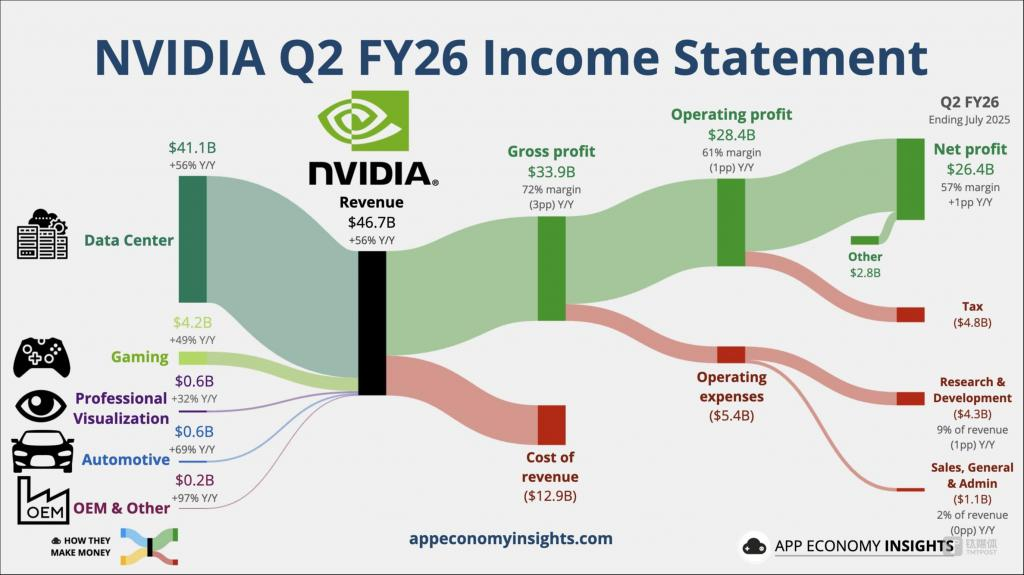
- Revenue: $46.74 billion, up 56% YoY and 6% QoQ, slightly above expectations.
- Net Income: $26.42 billion, up 57% YoY.
- Gross Margin: 72.4%, down 2.7 percentage points YoY.
- EPS: $1.08, up 61% YoY.
The data center segment remained the growth engine with $41.1 billion in revenue, up 56% YoY, though growth momentum slowed. Revenue from Blackwell architecture products rose 17% QoQ.
China Revenue Slumps
NVIDIA’s Q2 revenue from China was just $2.769 billion, down 24.5% YoY.
Due to U.S. export restrictions on H20 chips, the company made no shipments of H20 to Chinese customers, dragging down overall H100/H20/H200 sales by over 4%.
CEO Jensen Huang reiterated that China remains a key growth market, projecting a potential $50 billion opportunity, though current guidance excludes H20 sales to China.
Market Reaction
Despite guiding Q3 revenue at $54 billion (above the $53.5B consensus), it fell short of the most bullish $60B forecasts. NVIDIA’s stock plunged over 5% after hours before narrowing losses to under 2%, with market value evaporating by about $130B (RMB 930 billion), leaving a market cap of $4.43 trillion.
Industry Outlook
- Global: AI computing demand continues to surge, with Blackwell and NVLink seen as central to next-gen infrastructure.
- China: Domestic chipmakers (Cambricon, Biren, MetaX, etc.) are accelerating to fill the gap left by U.S. export bans.
- Forward Guidance: NVIDIA expects Q3 revenue between $52.9B–$55.1B, gross margin around 73–74%, and approved an additional $60B stock buyback.
Conclusion
NVIDIA remains the undisputed leader in AI chips, but slower data center growth and sharp declines in China are now its biggest risks. Its ability to maintain dominance globally while stabilizing its China presence will determine whether its market value can keep climbing.