AI video has once again captured the world’s attention, this time thanks to Sora. But unlike previous waves of excitement, the spotlight isn’t just on technological breakthroughs—it’s on the business models that might soon be rewritten.
On September 30, OpenAI officially unveiled Sora, a brand-new short-video social app with a vertical video feed design. Users can swipe horizontally to view multiple versions generated from the same prompt and create up to ten-second hyper-realistic videos with sound—all fully AI-generated, with no uploads from personal galleries allowed.
Initially, Sora is free to use, offering basic compute power to everyday users. OpenAI also plans to roll out developer APIs soon, signaling its ambition to expand into a full AI video ecosystem. In essence, Sora isn’t just launching a tool—it’s building a TikTok-like content feed, a platform.
This move sends a powerful message: the race in AI video is no longer about who has the best algorithm, but who can build the strongest ecosystem. Who controls the main content gateways? Who owns the compute and distribution infrastructure? Who can integrate the entire “creation–editing–distribution–monetization” chain? The age of isolated AI tools is ending, and the age of AI video platforms is beginning.
Just as GPT evolved into ChatGPT, the shift from model to platform redefines the entire value chain. The real question now isn’t whether AI can make a movie—it’s who can transform AI video from a creative tool into a true production platform. And for Chinese AI video pioneers, who were born out of platform ecosystems, where does their next opportunity lie? The industrial AGI framework is fast approaching.
The End of Tools: The Bottleneck of AI Video
Back in February 2024, a short AI-generated clip of a woman strolling through Tokyo streets went viral, turning Sora into a global phenomenon and sparking a surge of activity across the AI video landscape. Within months, Chinese players such as Keling and Jimeng AI had rolled out competitive models, many of which now rank among the top globally.
In the AGI-Eval global leaderboard, ByteDance’s Volcano Engine Seedance 1.0 claimed first place, while SuperCLUE’s July report ranked MiniMax, ByteDance, and Kuaishou among the top five. The pace of progress in AI video has matched that of any other cutting-edge vertical. With a global market exceeding USD 5 billion in 2024 and projected annual growth above 120% through 2026, the sector is booming.
But a hard truth remains: while one-click video generation is now possible, what comes next? Where do these clips go, and how do they fit into production pipelines? Most AI video tools are still stuck in demo mode—great for social posts, but not ready for large-scale integration into film, e-commerce, or advertising workflows.
Film production, for instance, involves hundreds of steps—from storyboarding and character design to shooting and compositing. Current AI tools address only fragments of this chain, often limited to concept art or script drafts. As a result, AI outputs impress but rarely replace core production capabilities.
Cost is another major constraint. High-quality video generation can still cost USD 30–50 per minute, even with optimizations from models like Doubao or Kling. For production houses, that’s more expensive than a seasoned 3D team. Meanwhile, creative efficiency hasn’t truly improved—video editors have become prompt engineers, spending endless hours fine-tuning inputs. AI video serves as a muse, not a workhorse.
The third bottleneck is ecosystem disconnect. Generating videos is just the start; real value lies in distribution and monetization. Early versions of Sora allowed quick generation but required users to export, re-encode, and re-upload content to social or ad platforms—breaking the workflow and killing retention. AI tools have enabled creation but haven’t embedded those creations into living content ecosystems.
Ultimately, AI video tools are one-off utilities. They can generate, but they can’t sustain. True scalability requires an organic loop of creation, distribution, feedback, and revenue. That’s why Sora has pivoted from a tool to a feed—to give AI content life within a platform. Whoever unifies the end-to-end chain will define the next generation of content platforms.
Two Paths: Model Ecosystems vs. Content Ecosystems
Globally, two distinct paths are emerging. In the West, companies like OpenAI, Runway, Pika, and LumaLabs follow a “Model + API + Community” approach. Their focus isn’t on consumer apps but on building scalable infrastructure. In this model, the core asset is the underlying engine: Sora 2 operates on GPT-5-level multimodal compute; Runway’s Gen-3 Alpha serves as a flexible framework for developers; Pika leverages community-driven feedback to enhance its models.
The strategy is clear—establish a technical moat through proprietary compute and models, then open APIs to attract developers and form a content network. The ecosystem thrives as users and developers continuously refine the models, creating a self-reinforcing loop.
However, this route faces challenges: slower commercialization, longer adoption cycles, and difficulty embedding into existing content systems. These models excel at creating capability but struggle to create context.
China, meanwhile, has chosen the opposite route—starting from application scenarios. Platforms like Kuaishou’s Kling, ByteDance’s Doubao, Tencent’s Hunyuan Video, Baidu’s Wenxin Video, and MiniMax are built for direct integration into business workflows such as e-commerce, advertising, and film production.
Kling, for example, focuses on video-commerce, enabling merchants to instantly generate product videos usable within Kuaishou’s backend. Jimeng AI integrates directly with Douyin’s ad platform, while Tencent’s Hunyuan powers IP-based semi-automated video generation for entertainment clients. These products prioritize seamless workflow adoption over demo spectacle.
This “content-first” logic shifts the competitive edge from model supremacy to distribution dominance. Compute and models can be shared or outsourced—but access to users, channels, and content ecosystems becomes the true moat. In other words, China’s advantage lies not in better technology, but in tighter integration with real-world content supply chains.
The results speak for themselves. As of mid-2025, Keling AI reported over 1.5 million monthly active users and 80% API renewal among enterprise clients, while Jimeng AI surpassed 20 million monthly actives by September. By contrast, overseas platforms like Runway remain reliant on a handful of film-studio clients, with limited consumer traction.
China’s integrated approach—anchored by content platforms with massive user reach—has allowed faster commercialization and tighter feedback loops.
The Road Ahead: Opportunities, Challenges, and Breakthroughs
Platformization is a marathon, not a sprint. Success depends on building systemic capabilities, not just models. China’s content platforms—Douyin, Kuaishou, Tencent Video, Xiaohongshu, Bilibili—already offer unmatched reach and monetization infrastructure. While global competitors are still debating model architectures, Chinese developers are embedding AI video directly into industrial workflows.
The shift is redefining the content logic itself: creation now means circulation. AI-generated videos can be distributed, monetized, and repurposed across multiple verticals. Industries like marketing, livestreaming, IP management, and education—all struggling with high production costs and creative fatigue—are finding new lifelines in AI-driven content.
But the path isn’t without hurdles. GPU costs remain high, domestic compute infrastructure is still maturing, and lack of interoperability between models and plugins slows scalability. Intellectual-property governance and licensing frameworks are also lagging, creating potential legal and trust risks. Unless these foundations strengthen, even the best platforms could stall early.
Encouragingly, leading players are already building “system-level” platforms. Keling and Jimeng are developing modular ecosystems of templates, plugins, and distributed rendering networks, partnering with cloud and chip providers to reduce cost and latency. They’re also introducing content-traceability and revenue-sharing frameworks to address copyright and incentive challenges—key steps toward sustainable governance.
As these gaps close, AI video platforms will evolve from mere creative tools into full-fledged digital infrastructure, redefining how the content industry operates.
AI Video and the Reinvention of the Content Industry
What AI video is truly transforming isn’t just how content is made—it’s how the entire industry is structured. China’s traditional content model has hit a ceiling: labor-intensive production, slow cycles, costly supply, and diminishing traffic returns. AI video platforms are cracking all three bottlenecks by unifying creation, editing, distribution, and monetization into a single system.
In this new paradigm, creators become creative operators, brands become direct clients, and platforms act as both factories and marketplaces. Once these elements converge, the content ecosystem gains industrial-scale efficiency—collaboration replaces fragmentation, and speed multiplies.
As Sora builds its app, and Chinese contenders integrate into Douyin or Kuaishou commerce pipelines, the groundwork is being laid for a new generation of “content industrialization.” Platforms like Douyin, Kuaishou, Tencent Video, Xiaohongshu, and Bilibili provide fertile ground for AI-driven ecosystems to flourish.
Once AI video platforms fully connect these networks, China’s content industry will leap from “content platforms” to “industrial platforms,” from “traffic distribution” to “content production + commercial conversion,” and from “creative-driven” to “intelligence-driven.”
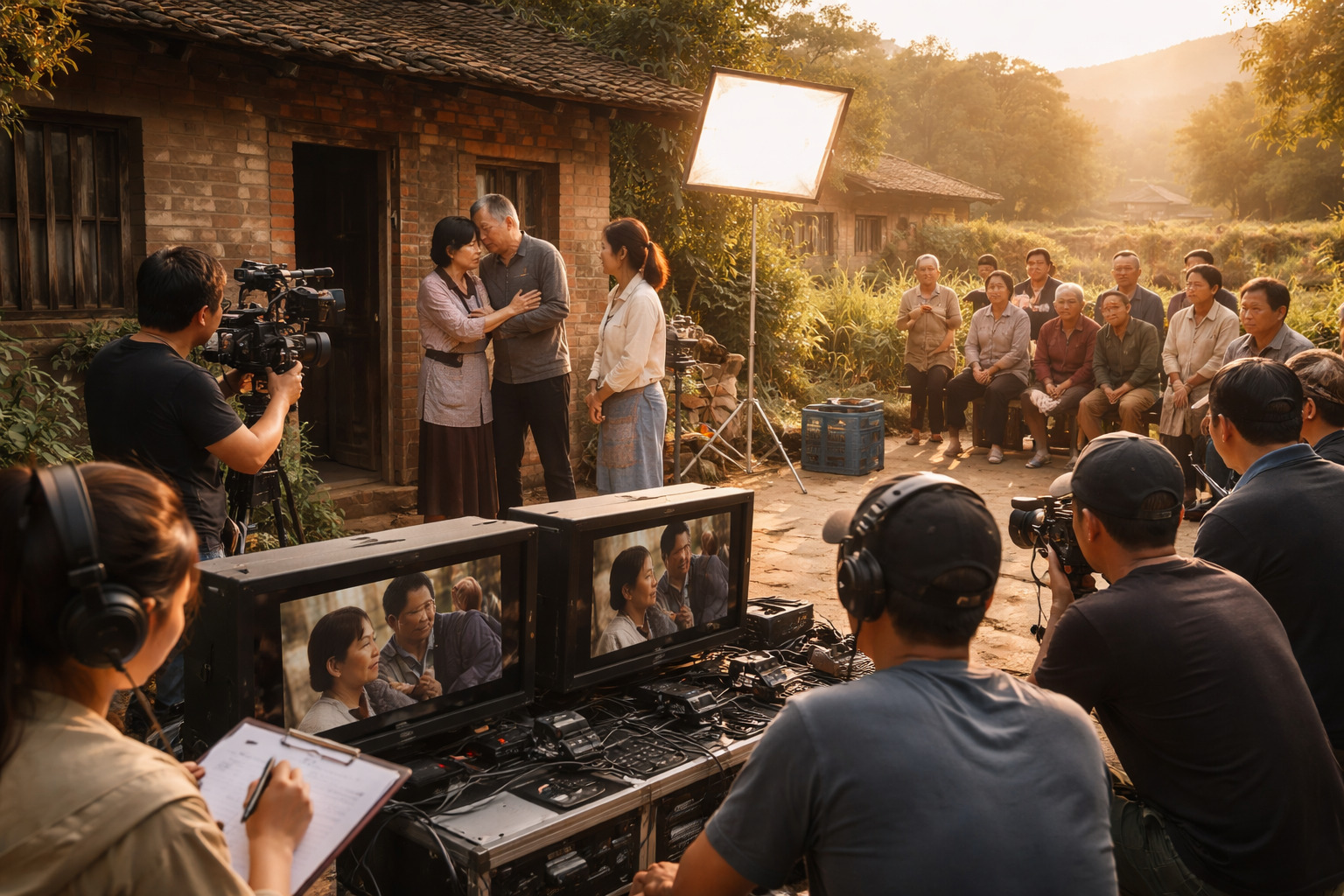
This evolution is already underway. Film studios like Bona Pictures have begun integrating AI video systems such as Seedream and Seedance into their production pipelines. New creative roles—AI visual directors, prompt engineers—are emerging, shaping a new collaborative production model that fuses human creativity with AI efficiency.
Nearly every major Chinese internet company is now racing to deploy large video models and AI-driven creative tools—not just to capture short-video growth, but to seize the inflection point where AI reshapes the content economy itself.
The next decade will redefine creativity as we know it. Ideas will no longer be scarce; models will amplify them exponentially. Production cycles will shrink from weeks to minutes. Content will cease to be mere entertainment—it will become the core asset of the data economy.
And in this new era, whoever builds the complete chain—from generation and editing to distribution and monetization—won’t just create a popular platform. They’ll own the engine of the next content industrial revolution—and perhaps, the foundation of the next AI platform age.