Key Takeaways
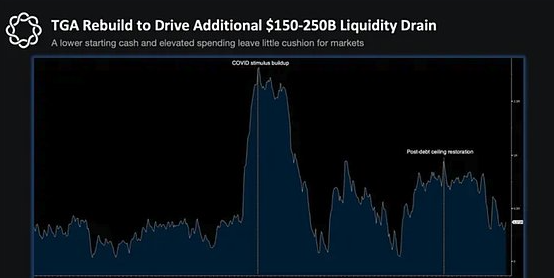
- Treasury Drain Incoming: The U.S. Treasury will rebuild its cash balance (TGA) by $500–600 billion over the next 2–4 months, targeting $850 billion.
- Safety Buffers Are Gone: Fed’s quantitative tightening, depleted RRP reserves, retreating foreign buyers, banks under pressure, and global de-dollarization all limit absorption capacity.
- Stablecoins Under Pressure: As crypto’s “cash rails,” shrinking stablecoin supply could choke market momentum.
- BTC vs. ETH & Altcoins: Bitcoin may act as the “safer asset,” while ETH and altcoins face sharper downside risks.
What TGA Refill Means
The Treasury General Account (TGA) is the U.S. government’s cash account at the Federal Reserve. To refill it, the Treasury issues new debt (mainly short-term bills). Investors pay cash for these Treasuries, draining liquidity from the financial system.
In 2023, a large TGA refill had minimal impact thanks to buffers: banks’ excess reserves, over $1T in RRP drawdowns, and steady foreign demand.
But in 2025, conditions are much weaker:
- Fed still tightening: Shrinking balance sheet by $60B/month.
- RRP nearly empty: Down from $2T to just $29B.
- Foreign buyers retreating: China and Japan cut long-term Treasury holdings.
- Banks under stress: $482B in unrealized bond losses and tighter regulations limit buying power.
- Global reserves shifting: USD share down to 58%, central banks adding more gold.
This time, liquidity will be drained directly from active markets.
Why Crypto Feels It First
Traditional markets will face higher short-term borrowing costs and tighter repo conditions. But crypto reacts faster because it depends heavily on stablecoins:
- When supply expands → crypto rallies.
- When supply shrinks → momentum collapses.
Historical comparison:
- 2021: Stablecoin supply +16%, crypto held strong.
- 2023: Supply –4.15%, ETH dropped ~13%, BTC remained resilient.
- 2025: With no buffers, stablecoins could contract sharply, hitting altcoins hardest.
Note: Stablecoins themselves are now major Treasury buyers.
- Tether & Circle together hold $120B+ in U.S. Treasuries.
- New compliant stablecoins like USD1 directly channel issuance into Treasury bills.
This creates a partial recycling loop, but it’s nowhere near enough to offset $500B+ in new issuance.
Possible Timeline
According to Delphi:
- Aug–early Sept: Calm phase, risk assets stay strong.
- Mid–late Sept (FOMC week): Treasury issuance spikes, liquidity tightens, volatility rises.
- Late Sept–Nov: Fatigue phase, stablecoin contraction, declining volumes, weak crypto (especially altcoins).
- Dec–Jan 2026: Relief phase—if issuance slows and stablecoins expand, risk assets may rebound.
This TGA refill is riskier than in 2023—no safety net remains, every dollar raised drains liquidity directly.
📌 Crypto will serve as the early warning system:
- A September stablecoin contraction would flash a red alert before stocks or bonds feel the strain.
- Hierarchy remains: In stress → BTC > ETH > Altcoins. In recovery → ETH may outperform if liquidity returns.
Expect turbulence through September–November 2025, with a potential rebound window by year-end or early 2026.