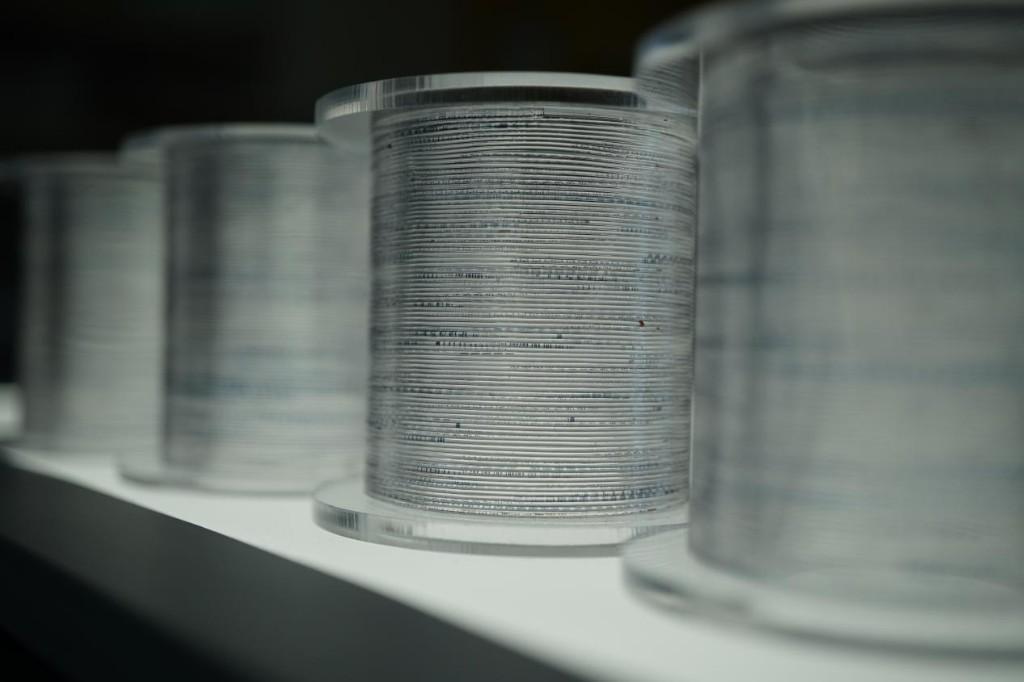
The push for flexible smart devices has long been constrained by a key bottleneck: chips, the “brains” of devices, have traditionally been rigid. Researchers Peng Huisheng and Chen Peining from Fudan University have successfully constructed large-scale integrated circuits inside elastic polymer fibers, creating a novel “fiber chip” that offers a new route to device flexibility. Their work was published in Nature on January 22.
Conventional chips are fabricated on flat, stable silicon wafers. The Fudan team introduced a “multi-layer spiral architecture”, embedding planar circuit layouts helically into thin fibers, achieving high-density integration in a one-dimensional confined space. Doctoral student Wang Zhen explains: “It’s like rolling a circuit-filled planar blueprint into a thin thread.”
Manufacturing high-precision circuits on soft, deformable fibers is extremely challenging. The team developed a process compatible with existing photolithography: plasma etching reduces polymer surface roughness below 1 nanometer, followed by deposition of a dense polystyrene layer, serving as a “flexible armor”. This protective layer resists solvent corrosion and buffers strain, ensuring stable circuit performance even after repeated bending and stretching.
The approach is compatible with current chip manufacturing processes and paves the way for fiber-based electronic systems. It holds promise for a shift from embedding chips into fibers to weaving electronics, potentially transforming brain-machine interfaces, e-textiles, and virtual reality applications.