The new year has barely begun, and another blockbuster acquisition has already taken shape.
According to a recent public filing on the Beijing Municipal Administration for Market Regulation’s website, Ruid Fashion plans to acquire a 75% stake in Beijing Badaling Outlets. After the transaction is completed, control of the project will be jointly shared with the existing shareholder. Behind Ruid Fashion stands Boyu Capital, making this deal yet another strategic move by the private equity heavyweight.
This means that following its involvement with Beijing SKP, Boyu has once again placed a bet on a top-tier, high-end shopping destination. Last year’s most talked-about consumer acquisition—the battle for Starbucks China, which drew intense interest from global PE funds—also ultimately landed with Boyu Capital in November 2025.
There is little doubt that 2026 will remain a hot year for consumer-sector M&A.
A Hottest-in-Class Outlet Is Changing Hands
Located about 55 kilometers from central Beijing and directly adjacent to the Jingzang Expressway, Badaling Outlets sits in Nankou Town, Changping District.
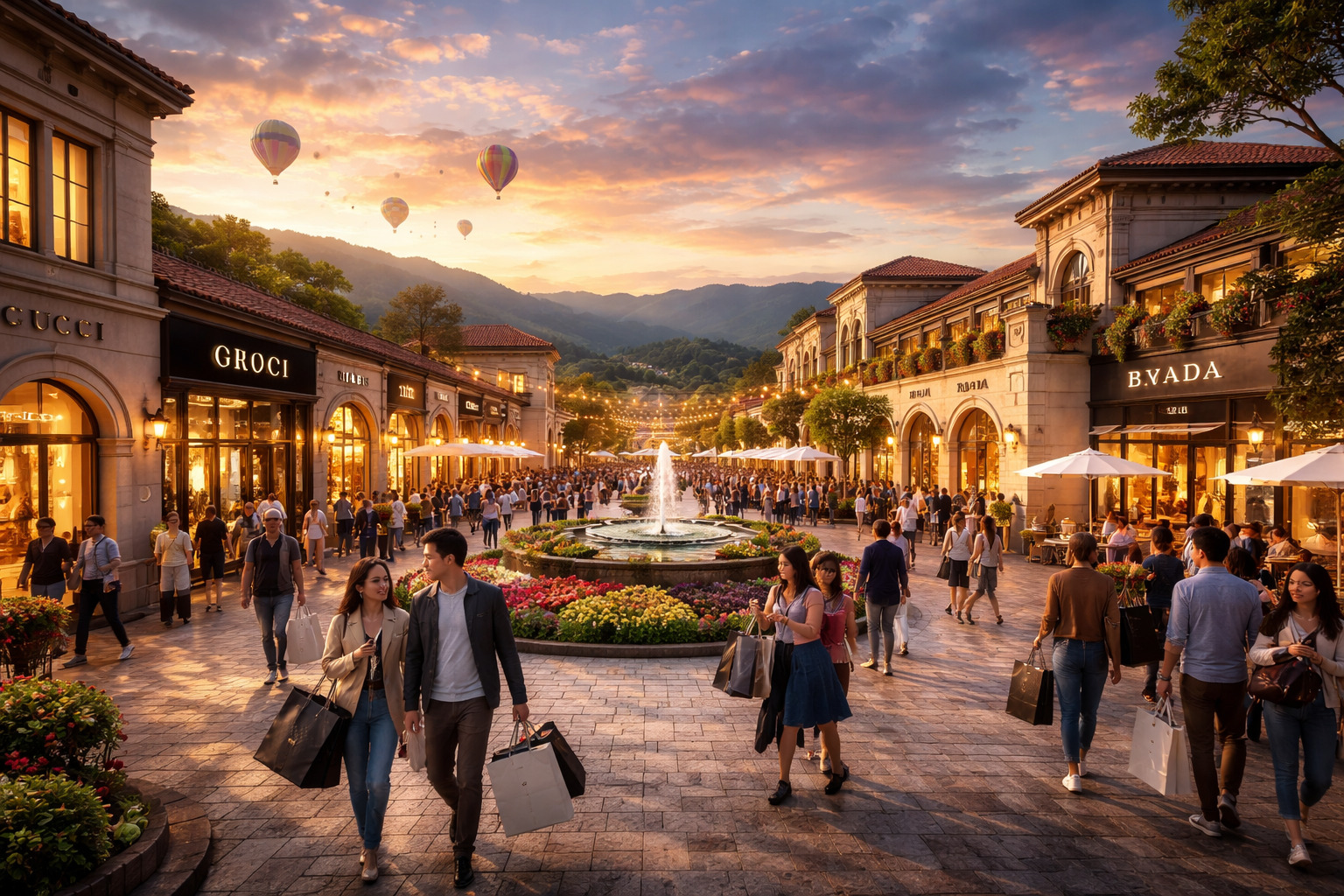
Developed by Beijing Hualian Group, this was the group’s first outlet mall project. With a total construction area of 115,000 square meters and 52,000 square meters of leasable space, the project adopts an open-air, “garden town” layout. Its ambition from day one was clear: a premium outlet offering attractive discounts and a strong experiential focus.
As the first truly “boutique outlet” in North China, Badaling Outlets has, since opening in September 2015, introduced nearly 300 international luxury brands, fashion labels, domestic boutique brands, and specialty dining concepts. The tenant mix includes heavyweight names such as Prada, Gucci, Burberry, and BVLGARI.
During holidays and major promotions, the scene is often striking: parking lots packed to capacity, cars queuing for entry, and long lines forming outside flagship stores.
Just how popular is it?
Sales figures tell the story. In its opening year alone, Badaling Outlets generated RMB 1.8 billion in sales, standing out among newly launched outlet projects at the time. In 2024, revenue reached approximately RMB 2.8 billion, with a profit margin of 34%. During the 2025 National Day holiday, the outlet recorded RMB 520 million in sales over seven days, welcoming 620,000 visitors—both all-time highs.
Turning back to the transaction itself, public disclosures show that prior to the deal, Jingpin Outlets held an 88.75% stake in the target company and exercised sole control. After the transaction, Ruid Fashion will indirectly hold 75%, while Jingpin Outlets will retain 25%, resulting in joint control.
Jingpin Outlets Investment Co. is closely tied to Hualian Group and serves as the core operating platform for Badaling Outlets. When the project first opened in 2015, it was jointly funded by Hualian Group, BTG Group, and Changping state-owned capital. After two rounds of equity restructuring, Hualian gradually became the controlling shareholder through Jingpin Outlets.
Ruid Fashion, the buyer, was established in 2025 as a dedicated platform created by Boyu Capital to consolidate its high-end retail assets. Quietly, Boyu has added yet another “top-traffic” shopping destination to its portfolio.
From SKP to Starbucks China: The M&A Powerhouse
Looking back at last year’s wave of acquisitions, Boyu Capital stands out as one of the most active and influential players.
The most headline-grabbing deal was its acquisition of a controlling stake in Starbucks China. In 2025, Starbucks decided to divest part of its China business, triggering fierce competition among PE firms. The bidding process attracted a long lineup of suitors, underscoring the asset’s appeal.
After prolonged negotiations, Starbucks announced on November 4, 2025, that it had reached a strategic partnership with Boyu Capital. The two parties agreed to form a joint venture to operate Starbucks’ retail business in China, marking the beginning of a new chapter for the brand in the market.
Under the agreement, Boyu may hold up to 60% of the joint venture, while Starbucks retains 40%. Starbucks remains the owner and licensor of the brand and intellectual property, authorizing their use by the joint venture. Based on an enterprise valuation of approximately USD 4 billion (excluding cash and debt), Boyu will acquire its corresponding equity interest.
At the time, Boyu partner Huang Yuzheng said the firm both believed in Starbucks’ long-term vitality and saw major opportunities to deliver more innovative and localized experiences to Chinese consumers. Starbucks Chairman and CEO Brian Niccol noted that Boyu’s deep local expertise would help accelerate Starbucks’ expansion in China, particularly in lower-tier cities and emerging regions.
In parallel, Boyu also acquired a stake in another crown jewel of Chinese retail: Beijing SKP.
In May 2025, the Beijing market regulator announced that Boyu’s fifth U.S. dollar-denominated fund, through affiliated entities, planned to acquire part of Beijing SKP’s equity. After the transaction, Boyu-related entities would indirectly hold approximately 42%–45% of SKP, while the mall’s existing management structure would remain unchanged.
Beijing SKP needs little introduction. Often described as a legend in China’s luxury retail industry, it has achieved single-day sales exceeding RMB 1 billion and has long been crowned “China’s top-performing mall,” effectively becoming synonymous with luxury retail.
That said, after more than a decade at the top, SKP experienced a pullback in 2024. According to third-party estimates such as Linkshop, sales declined 17% year-on-year to RMB 22 billion. For Boyu, however, this appeared less like a setback and more like an opportunity. Even by global standards, Beijing SKP remains a rare, high-quality asset capable of weathering economic cycles. When premium but large-scale assets see valuations normalize—and are even discounted for broader group considerations—they create ideal entry points for well-capitalized industry leaders and PE funds.
The Era of M&A in China
Over the past year, the pace of mergers and acquisitions has been relentless.
The consumer sector, in particular, has been especially active. In December, Sequoia China announced the acquisition of a controlling stake in global fashion brand Golden Goose, with Temasek and its wholly owned asset manager Pavilion Capital participating as minority investors.
Earlier in 2025, Sequoia China acquired a majority stake in Marshall at a valuation of €1.1 billion. Around the same time, DCP Capital acquired Sun Art Retail. This was followed by KKR taking over Dayao Soda, CPE buying Burger King China, and IDG Capital acquiring Yoplait China. One familiar brand after another has been placed on the M&A table.
Meanwhile, rumors of potential sales have circulated around Canada Goose, Häagen-Dazs China, Decathlon China, Costa Coffee, JDE Peet’s (owner of Peet’s Coffee), and outdoor brands such as Woolrich, Mammut, and Puma—often with Chinese capital appearing on the bidder lists.
A partner at an M&A-focused fund recently told investors that there are at least a dozen similar assets currently in the market, all “lining up to close transactions.”
Why has consumer M&A become so intense? At a recent Zero2IPO conference, Wang Wei, Managing Director at DCP Capital, explained that the essence of buyout funds lies in acquiring companies and leveraging their cash flows to increase leverage, amplify returns, and generate value through operational and cash-flow improvements.
Stable cash flows are most commonly found in so-called “traditional industries,” with consumer businesses being a prime example. As many investors agree, consumption has long been viewed as a rigid-demand, counter-cyclical sector, making it especially attractive during periods of economic uncertainty.
“China’s M&A bargain-hunting moment has arrived.”
Over the past year, many investors have echoed this sentiment. After more than two decades on the fringes, M&A in China has moved decisively toward center stage. As one buyout fund partner recently put it, “With real market demand, the growth of M&A in China can no longer be contained.”
A powerful signal followed shortly thereafter. At a recent press conference held by the State Council Information Office, Wang Changlin, Vice Chairman of the National Development and Reform Commission, stated that China would study the establishment of a national-level M&A fund, strengthen guidance on government investment fund allocation, and accelerate the development of new productive forces.
We are living through this turning point in real time.