On February 6, the National Health Commission released the Food Safety National Standard for Prepared Dishes (draft for public consultation), officially inviting feedback from the public.
Among all the provisions in this draft, the most eye-catching—and also the most controversial—is a single clause:
Finished or semi-finished dishes produced by central kitchens are not included in the scope of “prepared dishes” management.
Many consumers, drawing on their understanding of the back-of-house operations of chain restaurants such as Xibei, argue that food produced by central kitchens should also be classified as prepared dishes and clearly labeled as such. As a result, both Jia Guolong’s earlier claim that “Xibei has no prepared dishes” and the exclusion of central kitchens in the draft standard have been met with widespread confusion and rejection from the dining public.
Regulators were fully aware of this public sentiment when drafting the national standard. Yet they still chose not to include central-kitchen products within the definition of prepared dishes. The reason is simple: there are broader considerations at play.
This article does not attempt to judge whether this clause is right or wrong. Instead, it aims to objectively analyze the key reasons why dishes produced by central kitchens are excluded from prepared-dish regulation. These considerations are rooted primarily in the structure and development of the catering industry. They are far removed from everyday consumer perception, which is also why emotional understanding or acceptance from consumers is difficult to expect.
Reason One:
No requirement for individual packaging and labeling
When you eat snacks such as biscuits or chicken feet, you may have noticed the phrase “This package is not the minimum retail unit” printed on the wrapper.
This line is essentially a disclaimer—and a safeguard against penalties. Packages with this statement often lack information such as manufacturer details, shelf life, ingredient lists, or nutritional labels, making them look like “three-no products.” In reality, these small packages are taken from a larger outer package that already contains complete labeling information. As long as the inner packs are not sold separately, there is no legal requirement to duplicate that information.
The underlying principle is straightforward: any pre-packaged food sold openly must comply with strict packaging and labeling requirements, and the information must accurately match the product. Failure to do so can result in penalties.
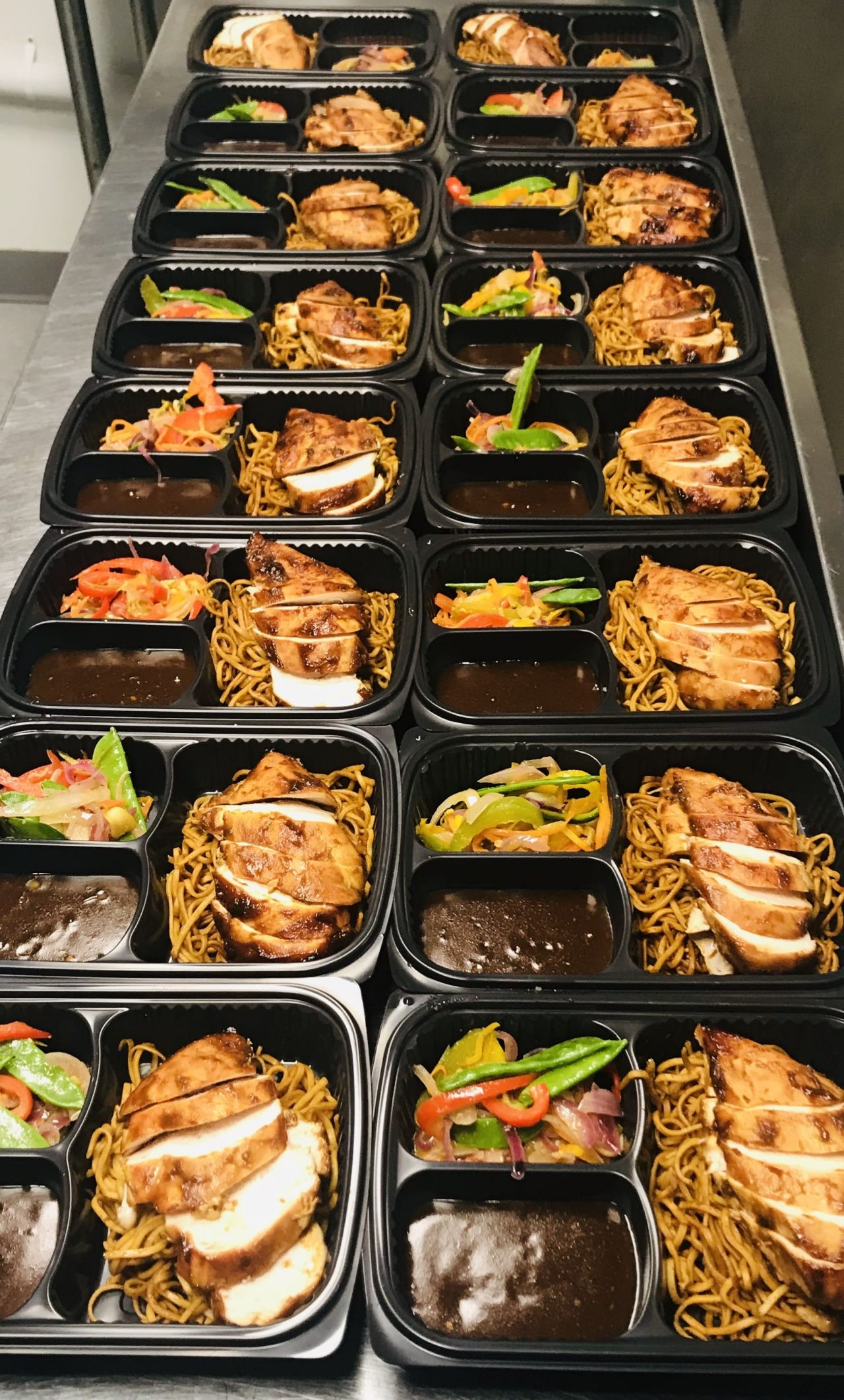
Applying this logic to central-kitchen dishes, once they are classified as prepared dishes—essentially a type of pre-packaged food—they would be required to use standardized packaging with full labeling. This means clearly listing ingredients, protein content, fat content, sodium levels, and the exact net weight of each portion.
Crucially, this information cannot simply be estimated. Each dish would require separate nutritional testing, precise weighing, and a dedicated batch of printed packaging and labels. All of this translates directly into additional time and financial costs.
Unlike factory-produced prepared dishes that are sold nationwide in batches of hundreds of thousands, regional central kitchens usually serve only one city, supplying a handful—or at most a dozen—restaurants.
Take Xibei in Guangzhou as an example: it operates fewer than ten outlets. In such a central kitchen, each dish might only be produced in quantities of a few thousand portions. When the cost of nutritional testing, packaging, and labeling is spread across such limited volumes, it could easily add four or five yuan per dish—meaning the final menu price might rise by around ten yuan.
If these dishes are not classified as prepared dishes, central kitchens can simply use plain food bags and reusable transport containers to distribute meals to their outlets. In that case, the packaging cost per dish might be only a few cents.
A household analogy makes this even clearer. In my family, it’s tradition to prepare large batches of fried meatballs and lotus root fritters before Lunar New Year, freeze them, and then take small portions to steam or cook noodles later. Sometimes we even share them with relatives and neighbors. If someone demanded that my mother print custom packaging, buy a vacuum sealer, and install a date-stamping machine for these homemade foods, she would think they had completely lost their mind.
Reason Two:
No need to pay 13% value-added tax
For those unfamiliar with the details, pre-packaged foods in China are subject to a 13% value-added tax (VAT). In other words, for a 100-yuan box of biscuits, 13 yuan goes to VAT. By contrast, vegetables and meat purchased from wholesalers are taxed at 9%, while primary agricultural products sourced directly from farms are tax-exempt.
In practice, biscuit manufacturers can offset part of this tax through input VAT deductions on raw materials such as flour, sugar, and cooking oil, so their effective tax burden is lower than the nominal 13%.
However, the situation is very different for central kitchens. If their products are not classified as prepared dishes, they can be treated as primary agricultural or semi-processed products, subject to VAT rates of 9% or even 0%. Once they are reclassified as prepared dishes, they fall squarely into the pre-packaged food category, where the 13% VAT rate is unavoidable.
That difference—between 4% and 13%—may not sound dramatic at first. But a real-world example makes its impact unmistakable.
In 2024, Haidilao reported revenue of 42.7 billion yuan and net profit of 4.7 billion yuan, for a net margin of around 11%, an exceptional figure in the large-scale catering industry. Haidilao, like almost all major hotpot chains, relies heavily on a central-kitchen supply model.
If central-kitchen products were reclassified as prepared dishes and taxed at 13% during the transfer from central kitchen to restaurant outlets, Haidilao’s profits would be wiped out entirely—and it could even slip into losses.
Of course, no restaurant chain can operate indefinitely at a loss. If tax costs rise, menu prices will inevitably go up, or businesses will be forced to shut down.
Reason Three:
Encouraging central kitchens to promote branding and standardization in catering
According to the 2025 China Catering Chain Development White Paper, China’s restaurant chain penetration rate reached 23% in 2024. By comparison, the United States stands at nearly 60%, about 2.6 times higher than China.
For consumers, chain restaurants bring standardized flavors, hygiene, and pricing—though often at the cost of culinary individuality. Whether this is good or bad depends on what one values more.
From a government perspective, however, the benefits of chain development are substantial.
First, food safety incidents occur far less frequently, and regulatory oversight is significantly more efficient.
Second, large chain enterprises tend to pay taxes fully and transparently, while small family-run restaurants often underreport or avoid taxes altogether.
Third, employment practices are more standardized. Even outsourced staff are generally employed under contracts with social insurance coverage.
Unsurprisingly, governments at all levels have strong incentives to promote branding, chain expansion, and standardization in the catering industry. For restaurants, the first step toward becoming a chain is establishing city-level central kitchens, which help control food quality, ingredient costs, and hygiene standards.
If a national standard were to discourage the establishment of central kitchens, there would be little motivation for authorities to push it forward.
In short, from the standpoint of fostering the healthy development of the catering industry, regulators have little desire to include semi-finished dishes from central kitchens within prepared-dish management.
If public pressure continues to demand that central-kitchen products be regulated as prepared dishes—and therefore as pre-packaged foods—the resulting compliance and tax costs will inevitably push prices higher.
As the saying goes:
There is no perfect solution—avoiding prepared dishes and avoiding price hikes rarely go hand in hand.